Online slots Australia
Work out what a sign-up bonus really costs before you deposit a dollar: this page assumes you must clear a 40x wagering requirement on the bonus amount alone, and every figure below is in AUD throughout. A A$100 bonus at 40x means A$4,000 of slot turnover before a single dollar of it converts to withdrawable cash, and that is the assumption you should carry into every offer you read.
Online slots sit in the most heavily contested corner of the Australian market, and the operators who chase this audience pay for visibility in places that take money for placement. This sponsored block is one of those places: the commercial arrangement behind it is disclosed on the How this site is paid page, so read that page first if you want to know which parts of what follows are paid for and which are not. The practical question for a reader is not which pitch sounds loudest but which set of written terms survives contact with the federal statute book, and that is what the sections below work through.
Offers in this block are advertising. Placement and order are paid. The wording inside each entry is supplied by the operator and reproduced without alteration. Terms are set by the operator.
- welcome package 100% up to 4000 aud + 1200 fs + bonus game
- first deposit bonus 100% up to 1000 aud + bonus game + 300 fs
- second deposit bonus 100% up to 1000 aud + 300 fs
- first deposit bonus 120% up to 5000 aud + instant bonus round + 250 fs
- second deposit bonus 100% up to 2500 aud + 250 fs
- third deposit bonus 80% up to 2500aud + 250 fs
- welcome package 600% up to $4800 + 255 free spins
- daily cashback 10%
- weekly rakeback bonus! the genie grants your wishes!
- CRYPTO WELCOME BONUS 140% UP TO 1,600 USDT +140 FS
- CASINO WELCOME PACK 570% Up To $11,400 + 270 FS
- VIP WELCOME PACK 850% UP TO $27,000
- starting bonus package up to 5200 au$ + instant bonus round + 1500 free spins
- first deposit bonus 100% up to au$300 + instant bonus round + 100 free spins
- highroller bonus 100% up to au$3,000
What a slot is under the Act
The legal starting point for any online slot in Australia is not the marketing copy on an operator's landing page but section 4 of the Interactive Gambling Act 2001. That section defines what counts as a gambling service, and paragraph (e) brings within the definition a service that supplies, whether by chance or partly by chance and partly by skill, a game that is played for money or something else of value, where a customer gives consideration in the course of, or for the purposes of, the supply of the service. A modern video slot is the clearest illustration of that language available: the outcome is determined by a random number generator, that is chance, the spin is played for a stake, and the stake is money or money's worth given as consideration. There is no serious argument that a slot falls outside paragraph (e), and nothing on this page should be read as suggesting otherwise.
Why does the definition matter so much? Because the whole structure of the Act hangs off it. Once a slot is a gambling service, the question becomes where that service is being supplied and to whom, which is the work done by section 5. The definition also disposes of an argument that sometimes surfaces in forum discussions, that a slot with a bonus feature or a free spins round is somehow a skill game. The statutory test does not ask whether the player can influence the result; it asks whether chance is involved at all, or chance in combination with skill, and the presence of any skill element in a game of chance keeps it inside the definition rather than pushing it outside. A player who lines up symbols is not applying a skill that changes the outcome of a spin.
The consideration element is equally broad. It is not limited to the deposit; it extends to anything of value the customer gives for the purposes of the supply. That is why the definition travels with the service across different commercial formats, whether the player pays by card, by crypto rail or by some voucher system, and whether the stake is described as a bet, a spin or a wager. The label an operator attaches to the transaction does not change the statutory characterisation. For a reader trying to understand how the federal framework treats online slots, the definition in section 4 is the anchor, and everything downstream should be read in its light.
One consequence worth stating plainly: the definition does not contain a carve-out for operators based overseas. Whether a service is a gambling service is a question about the nature of the service, not about the residence of the entity providing it. The geographic question is dealt with at the next stage, when section 5 asks whether the service is being supplied in the course of business to customers using an internet carriage service. Keeping those two steps separate is essential to reading the rest of this page correctly, because the prohibition regime turns on the second step, not the first.
The prohibition the industry works around
Section 5(1) defines a prohibited interactive gambling service, and the definition has three moving parts: the service must be provided in the course of business, it must be provided to customers using an internet carriage service, and it must be a gambling service. Where all three are satisfied, the service is prohibited. A slot product offered by a commercial operator over the open internet to players in Australia meets all three limbs, and this is the load-bearing point of the entire page. There is no category of licensed online casino in Australian federal law into which such a product could be slotted. The Act does not create one, no regulator administers one, and no operator holds one.
The exemptions in section 5(3) are sometimes invoked as if they opened a door. They do not open this one. The exclusions deal with other kinds of service, and online casino play from a customer's home is not among the things excluded. The result is that the product a reader is most likely to be shopping for, a slot library accessible from a phone or laptop in an Australian lounge room, sits squarely inside the prohibition. That is a statement about how the law classifies the service, not a statement about the reader, and the distinction matters. The Act channels its prohibitions towards providers and those who assist them; it does not set out a player-side offence in the terms that are available to read, and this page does not assert what the position of an individual player is, because that is not published in a form that could be cited here.
It follows that offers pointing an Australian reader at an online slot product are offers in a market where the domestic licensed product does not exist. The comparison that gets made in some places, between an Australian licence and an offshore licence, is a comparison with an empty set: there is no Australian online casino licence for the offshore operator to be compared against. What actually exists is a set of offshore licences issued by other jurisdictions, each with its own supervisory regime, and a federal prohibition aimed at the supply of the service into Australia. A reader who keeps that picture in mind will read operator terms very differently from one who assumes a domestic licence is out there somewhere.
None of this is a technicality that operators can engineer around by re-labelling. The prohibition attaches to the service, and the service is the supply of the game to the customer. Moving the server, changing the corporate entity, or presenting the product as a social or sweepstakes variant does not change the statutory question, which is whether what is being supplied is a gambling service provided in the course of business to customers over the internet. Where it is, section 5(1) applies on its terms. The practical consequence for a reader is that the legal footing of any offer worth considering is offshore, and the terms that matter are the ones the offshore operator publishes, not a licence that does not exist at home.
Reasonable diligence and the provider
Section 15(4) sets out the factors a court weighs when assessing whether a person has exercised reasonable diligence in relation to a prohibited interactive gambling service. The section is directed at the conduct of providers and those connected with them, and its factors are the kind of thing you would expect: the person's knowledge of the facts that made the service prohibited, the steps taken to find out, the systems in place, and what a reasonable person in that position would have done. It is a defence-shaped provision, and it is worth understanding because it explains why the enforcement architecture of the Act looks the way it does. The law does not rely only on catching an operator red-handed; it builds in a standard of diligence that intermediaries and service providers are expected to meet.
For a reader, the relevance of section 15(4) is indirect but real. The diligence standard shapes how payment processors, advertisers, app stores and internet service providers behave when a slot product is pointed at Australian customers. Where those intermediaries take the standard seriously, the practical availability of a service can change quickly, and an operator's published terms can become stale almost overnight. A payment rail that worked last month may be gone, a deposit method may be withdrawn, and a withdrawal route may change. That is one reason the comparison further down this page marks any term the operator did not publish where it could be read, rather than filling gaps with guesses.
The diligence provision also tells you something about how the Act thinks about responsibility. It is not solely a matter of the operator's own conduct; it contemplates a chain of people, each of whom may need to show they took reasonable steps. An operator that markets aggressively into Australia while claiming ignorance of the customer base is in a weaker position under section 15(4) than one that can show it took active steps to exclude a market. For the reader, this is a reminder that the commercial pressure on an offshore operator runs in the direction of continuing to take deposits, and the legal pressure runs in the other direction. Where the two collide, the customer is the one left holding an account whose terms may be revised without notice.
There is a limit to what can be said about section 15(4) with confidence. The provision sets a standard; how it will be applied to any particular operator or intermediary depends on facts that are not published. This page does not assert that any named brand has or has not met the standard, and it does not predict enforcement outcomes. What it does is flag the standard as the mechanism by which the prohibition in section 5(1) is given practical effect against the surrounding commercial ecosystem, which is where a reader's deposit and withdrawal experience is actually determined.
Penalties and what is not published
Penalties under Commonwealth law are expressed in penalty units, and the value of a penalty unit changes over time by instrument. For offences committed on or after 1 July 2026, the figure is A$364, set by the Crimes (Amount of a Penalty Unit) Instrument 2026, which was made on 15 June 2026. Before that, the value was A$330 from 7 November 2024, and A$313 from 1 July 2023 to 6 November 2024. Those are the published figures, and they are the only figures this page will quote for the unit itself. Multiplying units by a value is arithmetic, but the number of units attached to a particular offence is a separate question, and one this page does not answer.
Here the trail goes cold, and it is important to say so rather than to fill the gap. No primary source states a dollar maximum penalty under section 15. Nothing is published on that point in a form that could be cited, and this page will not manufacture a figure by multiplying a unit value by a number it has not verified. Readers who encounter a confident dollar maximum for a section 15 offence should treat it with scepticism until they can trace it to the instrument that sets the unit count, because the unit value and the unit count are different things and only the first is settled by the published instrument above.
The same discipline applies to two other questions that come up constantly. On the player side, nothing is published that states a player commits no offence, and this page will not say it. The offences in the Act are written about providers, and the way to describe the statute accurately is to describe what it says about providers, not to extend it into a reassurance about the reader. On the contractual side, no regulations under section 69A have been located, and this page will not assert that any agreement is enforceable or unenforceable. Both of those are questions on which the published material is silent, and silence in a statutory scheme is not the same as a favourable answer.
Why dwell on the gaps? Because the commercial pitches that reach Australian readers tend to smooth them over. A landing page will imply that a licence somewhere makes everything straightforward, that a contract will be honoured on the operator's terms, and that the customer has remedies at hand. None of that follows from the statute as published. A reader who understands that the dollar maximum is unpublished, that the player-side position is unpublished, and that the enforceability question is unpublished will approach an offer with the right level of caution, which is to say a high one.
Comparing the offers
The grid below sets out the headline welcome terms for a set of offshore brands that market to Australian readers. Every figure in the welcome offer, wagering, minimum deposit and payout columns is the operator's own stated term or amount, and amounts stay in the currency the brand publishes rather than being converted into any other currency. Where a brand did not publish a term where it could be read on the date in the header, the cell reads Check on the operator's own site, which is a marker for a gap, not a claim that the term does not exist. The brands are listed as written, and the order carries no meaning beyond presentation.
| Brand as written | Welcome offer (operator's own stated terms) | Wagering (operator's own stated terms) | Minimum deposit (operator's own stated terms) | Payout window (operator's own stated terms) | Payment rails (operator's own stated terms) |
|---|---|---|---|---|---|
| Joe Fortune | Check on the operator's own site | Check on the operator's own site | Check on the operator's own site | Check on the operator's own site | Check on the operator's own site |
| Ignition Casino | Check on the operator's own site | Check on the operator's own site | Check on the operator's own site | Check on the operator's own site | Check on the operator's own site |
| Fair Go Casino | Check on the operator's own site | Check on the operator's own site | Check on the operator's own site | Check on the operator's own site | Check on the operator's own site |
| Ricky Casino | Check on the operator's own site | Check on the operator's own site | Check on the operator's own site | Check on the operator's own site | Check on the operator's own site |
| Uptown Pokies | Check on the operator's own site | Check on the operator's own site | Check on the operator's own site | Check on the operator's own site | Check on the operator's own site |
| Red Stag Casino | Check on the operator's own site | Check on the operator's own site | Check on the operator's own site | Check on the operator's own site | Check on the operator's own site |
| Slotocash | Check on the operator's own site | Check on the operator's own site | Check on the operator's own site | Check on the operator's own site | Check on the operator's own site |
| Golden Euro Casino | Check on the operator's own site | Check on the operator's own site | Check on the operator's own site | Check on the operator's own site | Check on the operator's own site |
| Wildz | Check on the operator's own site | Check on the operator's own site | Check on the operator's own site | Check on the operator's own site | Check on the operator's own site |
| Lucky Nugget Casino | Check on the operator's own site | Check on the operator's own site | Check on the operator's own site | Check on the operator's own site | Check on the operator's own site |
Note: No Australian licence exists for this product. The Check on the operator's own site marker indicates a term the operator did not publish where it could be read on the date in the header above.
Read the wagering column before the welcome column, every time. A welcome figure is the number that gets the click; the wagering term is the number that decides whether the click was worth making. An offer that expresses wagering as a multiple of the bonus amount behaves very differently from one that applies the multiple to the bonus and the deposit together, and the gap between those two formats can run to thousands of dollars of turnover on a modest bankroll. Where the row shows the check marker instead of a figure, that is precisely the point at which a reader should stop treating the offer as comparable and go to the source, because a missing wagering term cannot be evaluated at all.
The payout window and the payment rails deserve equal attention and rarely get it. A generous-sounding bonus that locks withdrawals behind a pending period, or that pays only through a rail the reader cannot use, is worth less than a plainer offer that pays promptly. Operators also revise rails, and a method that worked at the time of writing may not be available later, which is a further reason to verify current terms rather than relying on any comparison at a fixed point in time. The column headed with the operator's own stated terms exists to keep those figures in the currency and format the brand published, so that nothing is smoothed over by conversion.
Budgeting slot spend
The calculator below is a budget tool, not a return predictor. It takes a deposit amount, a bonus amount and a wagering multiple, and it returns the total turnover required to clear the bonus under the assumption that the multiple applies to the bonus amount alone. That assumption is stated at the top of the page and repeated here because it is the single most common source of surprise: many operators apply the multiple more broadly, and where they do, the true turnover figure is higher. Nothing in the tool estimates a win, an expected return or a session length, because none of those can be derived from the inputs.
Turnover required to clear the bonus: A$4,000.
This is the bonus multiplied by the multiple. It does not include the deposit, it does not model any contribution weighting, and it does not account for any term that applies the multiple to the deposit and bonus together.
Two further cautions apply to anything the tool shows. First, turnover is not spend. A player who turns over A$4,000 on slots has not necessarily lost A$4,000, but equally has not necessarily kept anything, and the figure says nothing at all about the likelihood of either outcome. Presenting turnover as a cost is as misleading as presenting a bonus as free money. Second, the multiple is not the whole term. Contribution weightings can mean that some play counts only partially towards the requirement, and any weighting changes the effective turnover without changing the headline multiple. Since this page does not state any return figure for any product in Australia, the calculator stops at the arithmetic and leaves the rest to the operator's published terms.
Use the tool as a discipline, then. Put in the deposit you can actually afford to lose, the bonus the operator actually offers, and the multiple the operator actually publishes. If the resulting turnover figure makes you uncomfortable, the offer is not for you, and no amount of liking the slot library changes that. The number that should drive the decision is the one in the result line, not the one in the welcome banner, and the difference between those two numbers is the entire subject of this section.
Blocking and the referral figures
Enforcement against prohibited services does not run only through prosecutions. A significant part of the practical effort goes through site blocking, where the regulator refers websites to internet service providers so that access is obstructed at the network level. The figure below sets out the referral counts as each quarterly report states them, and the caption explains why the three numbers must not be treated as an additive series. Readers who want to understand how quickly the digital ground under an offer can shift should pay attention to the scale and pace of those referrals rather than to any single quarter in isolation.
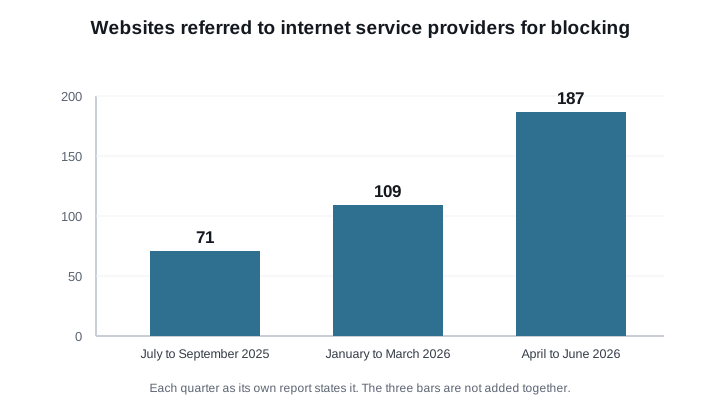
What does a blocking referral mean for a reader with an account at an offshore brand? It means the address you used last month may not resolve next month, and an operator may respond by moving domain, which in turn means the terms you agreed to may now sit under a different front door. Blocking does not seize funds and does not adjudicate a contract; it obstructs access. The consequence is practical rather than legal for the reader: a service that is harder to reach is also harder to complain to, and an operator whose main domain has been referred has an incentive to redirect customers quickly, sometimes to a mirror that publishes revised terms.
The caption's warning about the bars not being additive is worth restating in plain terms. Quarterly referral figures describe activity within a quarter, and nothing published allows them to be summed into a running total covering the whole period. A reader who sees a large cumulative number quoted in commentary should ask which quarterly reports it came from and whether the reporter has simply added them, because that is a construction, not a published statistic. The three figures above are the ones that each quarter's own report states, and they should be read as three snapshots.
For a reader weighing an offer, the sensible inference is about durability, not about any particular brand. A market subject to sustained blocking activity is a market in which any individual offer can become unreachable or can be republished on new terms with little notice. That is an argument for reading the terms at the point of deposit and again at the point of withdrawal, and for keeping a record of what was published when. It is not an argument about the merits of any named operator, and this page makes none.
Questions about online slots
- Are online slots legal to play in Australia?
- This page does not answer that question, because nothing is published that states a player commits no offence. What is published is that online casino services supplied in the course of business to customers over the internet are prohibited under section 5(1) of the Interactive Gambling Act 2001, and that the offences are written about providers. Read the statute and the operator's terms, and do not treat any marketing claim about legality as a legal opinion.
- Is there an Australian licence for an online casino?
- No. No category for a licensed online casino exists in Australian federal law. A slot product offered to an Australian reader over the internet is not operating under an Australian online casino licence, because the regime does not create one. Any licence an operator holds was issued by another jurisdiction and is subject to that jurisdiction's rules, not to an Australian one.
- What does a 40x wagering requirement actually mean?
- It means you must turn over 40 times the amount the multiple applies to before the bonus converts. If it applies to a A$100 bonus alone, that is A$4,000 of turnover. If the operator applies it to the deposit and bonus together, the figure is higher. Turnover is not the same as loss, and the multiple says nothing about the likelihood of ending ahead. Always check whether contribution weightings change the effective requirement.
- Why do some cells in the comparison say to check the operator's own site?
- Because the operator did not publish that term where it could be read on the date in the header. The marker is a statement about a gap in the published material, not a claim that the term does not exist or that it is unfavourable. Go to the operator's own page and read the term in full before relying on it.
- Does the Interactive Gambling Act 2001 apply to operators based overseas?
- The prohibition in section 5(1) turns on whether the service is provided in the course of business to customers using an internet carriage service, not on where the provider is incorporated. Section 4 paragraph (e) brings games of chance played for money against consideration inside the definition of a gambling service, and a slot meets that test. The definition and the prohibition should be read together.
- How much is a penalty unit?
- For offences committed on or after 1 July 2026, A$364, under the Crimes (Amount of a Penalty Unit) Instrument 2026 made on 15 June 2026. Before that the value was A$330 from 7 November 2024, and A$313 from 1 July 2023 to 6 November 2024. No primary source states a dollar maximum penalty under section 15, and this page does not supply one.
- Can I claim a bonus and then withdraw straight away?
- The bonus normally will not be withdrawable until the wagering requirement is cleared, and the operator's terms govern the withdrawal process, including any pending period. This page does not assert whether any agreement is enforceable or unenforceable, and no regulations under section 69A have been located that would settle the question. Check the operator's published cashout rules and keep a copy of them.
- What does a site blocking referral change for me?
- It changes access, not entitlement. A referral to an internet service provider for blocking obstructs reachability; it does not adjudicate a contract or seize funds. Practically, an unreachable site is harder to complain to, and operators sometimes move to a new domain and republish terms. Keep your own record of the terms in force when you deposited.
Licensing note
No Australian licence exists for the supply of an online casino or online slot product to customers in Australia. Section 5(1) of the Interactive Gambling Act 2001 defines a prohibited interactive gambling service by reference to the course of business, the use of an internet carriage service and the nature of the gambling service, and section 4 paragraph (e) brings a game of chance or mixed chance and skill, played for money or something else of value against consideration, inside the definition of a gambling service. The exclusions in section 5(3) do not carve out online casino play from a customer's home. Any licence held by a brand named on this page was issued outside Australia, by a regulator outside Australia, and confers nothing under Australian law. This page asserts nothing about whether a player commits an offence, nothing about whether any agreement is enforceable or unenforceable, and nothing about the availability of remedies, because none of those points is published in a form that could be cited here.
Where to go next
- Australian online pokies the pokies side of the same statutory picture, with the definitions walked through again.
- Live casino Australia dealer-led games, and why the section 5(1) analysis does not change with the format.
- High roller casino Australia how larger stakes interact with wagering terms and payment limits.
- Mobile casino Australia browser and app access, and what blocking referrals mean for reachability on a phone.
- Best Australian online casino how offers are assessed when no domestic licensed product exists to compare against.
- Free spins no deposit the small print behind no-deposit offers, and where the wagering usually hides.
- Reading the offers a method for comparing published terms without being misled by the headline figure.
- How this site is paid the disclosure that explains the commercial arrangement behind sponsored placement.