Best Australian online casino
The word "best" in the heading is the wording of a search query, not a verdict this page issues. Nothing here ranks operators by quality, scores them, or puts them in an order. What follows sets out what Australian law says about online casinos, what the regulator publishes about enforcement, and what four specific questions about this market can and cannot be answered from public sources.
The operator names and promotional wording in the block below are supplied by the advertising partner. Their placement on this page is paid for, not earned, and the order in which they appear is bought. Descriptions of those offers have not been edited by this site, and not one figure in them has been checked against an independent source. How placements are sold and marked is set out on How this site is paid. Nothing in that block is an assessment of an operator's quality, and no operator named there has been examined by this site.
Offers in this block are advertising. Placement and order are paid. The wording inside each entry is supplied by the operator and reproduced without alteration. Terms are set by the operator.
- welcome package 100% up to 4000 aud + 1200 fs + bonus game
- first deposit bonus 100% up to 1000 aud + bonus game + 300 fs
- second deposit bonus 100% up to 1000 aud + 300 fs
- first deposit bonus 120% up to 5000 aud + instant bonus round + 250 fs
- second deposit bonus 100% up to 2500 aud + 250 fs
- third deposit bonus 80% up to 2500aud + 250 fs
- welcome package 600% up to $4800 + 255 free spins
- daily cashback 10%
- weekly rakeback bonus! the genie grants your wishes!
- CRYPTO WELCOME BONUS 140% UP TO 1,600 USDT +140 FS
- CASINO WELCOME PACK 570% Up To $11,400 + 270 FS
- VIP WELCOME PACK 850% UP TO $27,000
- starting bonus package up to 5200 au$ + instant bonus round + 1500 free spins
- first deposit bonus 100% up to au$300 + instant bonus round + 100 free spins
- highroller bonus 100% up to au$3,000
Why this page does not rank operators by quality
An Australian reader typing "best Australian online casino" is usually asking for one of two things. Either they want a shortlist of places to play, or they want to understand the market before deciding whether to play at all. This page cannot do the first and will not pretend to. It can do the second.
The reason is not modesty. It is that there is no measurement that would support a quality ranking in this market, and there is no regulator publication that rates operators. The Australian Communications and Media Authority, which is the body that enforces the interactive gambling rules, publishes no register of offshore operators and no rating of any operator (claim 52). That is not an oversight in a database; it reflects what the regulator's job is. ACMA investigates and enforces, it does not grade. A page that produced stars, scores, vote counters or a numbered order would be inventing a metric that no public body maintains and no data set supports.
There is a second reason, specific to online casino. Under the Interactive Gambling Act, an online casino served to a person at home is a prohibited interactive gambling service, and no Australian licence exists for online casino (claim 5). The definition of a prohibited interactive gambling service sits in s 5(1) of the Act (claim 2), and the excluded categories are set out as a closed list in s 5(3) (claim 3). The statutory definition of a gambling service is in s 4(e) (claim 1). A regulated interactive gambling service is defined by s 8E(1) as a closed list, and an online casino is not on it (claim 14). The one gaming exclusion that the Act carves out is place-based (claim 4). In other words, the exception exists for premises, not for a website opened at home.
This matters for any discussion of quality because it means the operators a reader might want ranked are not operating under an Australian licence at all. They are outside the licensing framework, which is exactly why there is no local supervisory record of how they treat customers, how they handle disputes, or how their terms are drawn. A quality ranking of unlicensed operators would rest on nothing an Australian reader could check.
This page therefore does none of the following. It does not assign scores. It does not award stars. It does not count votes or display a poll. It does not describe any operator as recommended, trusted or safe. It does not claim that any named operator is better or worse than another. Where it uses the word best, it is quoting the search query that brought the reader here, and it says so plainly.
What the page does instead is narrower and more useful. It explains the legal position, it reports the enforcement numbers the regulator actually publishes, quarter by quarter, and it points to the four specific questions about this market that a reader can pursue in more depth. Those four questions are set out further down as the branches of this hub.
What can actually be measured: terms, not reputation
If quality cannot be measured, something else can. The terms of an offer can be read. A welcome bonus has a wagering requirement, a time limit, a maximum bet while the requirement is live, a cap on how much of the bonus can convert to withdrawable funds, and a list of games that count toward the requirement and games that do not. Those are facts about a document, and a reader can compare them across offers without anyone assigning a score.
This is the approach taken on Reading the offers, which walks through how a bonus clause is normally structured and which lines change the arithmetic most. The same approach underlies The margin we assume, which is about the house edge built into games rather than about any operator. Neither page ranks anybody. Both are about the numbers a reader can pull out of a terms page and check for themselves.
Deposit minimums are another measurable term. A site that advertises a low entry point is making a claim about a number, and the number can be found in the banking section of its terms. Minimum deposit casino Australia deals with that question directly. Again the point is comparison of stated terms, not a verdict on the business behind them.
Payment methods are a third. Australian rules restrict credit cards and cryptocurrencies for gambling services, and ACMA has reported a very high level of compliance with that ban, with no investigations commenced; a March 2025 review found 50 services still referring to credit card or crypto deposits, all of which had been removed by 30 June 2025 (claim 41). That is an enforcement fact about a payment rail, not a ranking of the sites involved.
The distinction to hold on to is this. Reputation is a story told about an operator by someone with an interest in the telling. Terms are a document the reader can open. The first cannot be verified from public sources in this market. The second can be read line by line. Everything this page recommends as a method leans on the second.
There is one more thing that can be measured, and it is the most important of all for an Australian reader: whether a service is of a kind that Australian law prohibits. That is not a matter of opinion or of terms and conditions. It is a matter of statutory definition, and the definitions are short. An online casino served to a person at home falls within the prohibited category (claim 5). ACMA's own compliance reporting describes the category the same way: online casinos that provide slots, roulette, poker and other casino games are prohibited in Australia (claim 17). The regulator also lists banned services as online casinos, in-play sports betting, sports betting services without an Australian licence, and betting on the outcome of a lottery (claim 16).
The four branches of this hub
This page is a hub. It does not try to answer every question about the Australian online casino market in one place. It points to four branches, each of which takes one question and follows it through. The four are chosen because each one is a question readers actually ask, and each one has an answer that can be built from public sources rather than from opinion.
The first branch is the self-exclusion gap. BetStop is the national self-exclusion register, and a reader who has excluded themselves through it may reasonably assume that every operator will honour that exclusion. The question is what happens with operators that are not part of the register's reach. Casinos not on BetStop takes that question. It is a question about coverage, not about which operator is better, and it connects to the wider point that BetStop's own route for an online casino complaint is ACMA (claim 158).
The second branch is verification and withdrawal. Some operators advertise that a customer can withdraw without identity verification, or with a lighter process than a licensed Australian bookmaker would run. The question is what that actually means for a customer, and what protections are given up when verification is thin. Online casino no verification withdrawal Australia works through that. It matters because ACMA has reported that winnings may not be honoured, that consumers have little or no recourse, and that these services do not have the customer protections expected in Australia (claim 37). A light verification process is not a substitute for those protections; it is often a sign that they are absent.
The third branch is new entrants. New online casino brands appear regularly, and the question a reader asks is what is actually new about them and what can be checked. New online casino Australia handles that. The short answer, developed on that page, is that novelty is easy to advertise and hard to verify, and that the things worth checking about a new brand are the same terms that matter for an old one.
The fourth branch is the top ten question. Readers search for a top ten list, and the honest response is to explain what such a list could and could not be built from. Top 10 online casino Australia real money takes that on. It does not produce a ranking. It explains why a ranking of this market by quality cannot be sourced, and what a reader can compare instead.
Two further pages sit alongside the four branches without being branches themselves. Australian online pokies deals with the game category most often searched for, and with the fact that the category is squarely within the prohibited definition. Knowing when to stop is the page for the reader who has decided to play somewhere and wants the self-control tools, including BetStop, in one place. Neither is a ranking, and neither is an endorsement of playing.
How the regulator publishes enforcement
ACMA publishes quarterly compliance reports, and those reports are the closest thing to a public record of what enforcement looks like in this market. They are worth reading carefully, because the numbers in them are specific and because they are often misquoted.
The enforcement powers themselves are civil and administrative, not compensatory. Part 8 of the Act sets out a toolkit running from s 64A to s 64G (claim 28). In plain terms, the regulator can investigate, warn, and take other administrative steps. What that toolkit does not do is recover money for a customer who has lost it. That is a crucial point and it is taken up in the next section.
The investigation power is broad. Under s 21(1), ACMA may investigate on its own initiative or on a complaint (claim 26). Standing to complain is set by s 19 (claims 27 and 157). Part 7A treats a designated interactive gambling service as including a prohibited one, and the relevant provisions are s 61DA and s 61EA (claim 19). The regulator can also refer the directors and principals of offending companies to the Australian Border Force (claim 30).
The published quarterlies give a sense of scale. In the quarter from April to June 2026, ACMA recorded 465 enquiries and complaints, of which 417, or 90 per cent, were valid; the monthly complaint counts were 118 in April, 145 in May and 154 in June (claim 42). In the same quarter it opened 30 investigations covering 76 gambling sites, found breaches in 27 of them, and recorded 56 breach findings (claim 43). It issued 18 formal warnings, referred 187 websites to internet service providers for blocking, and reported 187 URLs to family-friendly filter providers (claim 44).
The preceding quarter, January to March 2026, shows 422 enquiries, of which 366 were valid; 25 investigations into 60 sites; 13 formal warnings; and 109 websites referred for blocking (claim 45). The quarter before that, July to September 2025, shows 411 enquiries, of which 350 were valid; 29 investigations into 30 sites; 20 formal warnings; and 71 websites referred for blocking (claim 46).
Those per-quarter figures can be quoted with the quarter attached, and that is how they are used here. A cumulative figure is a different matter. No cumulative blocking total is available from any readable ACMA page. A news report carries the number 1,338 since November 2019, attributed in general terms, but that is a news report rather than a regulator's own number (claim 48). Per-quarter figures may be cited at source; a cumulative total may not be stated as a sourced figure. The same caution applies to the count of services that have left the market. Two ACMA pages give different counts, "over 100", "Over 220", and "about 220 over eight years", and no single one of those may be presented as the figure (claim 49).
Offshore expenditure is the third place where sources diverge. Two estimates in one ACMA document differ by about eight times, and no page may state a single number for Australian offshore spend (claim 50). A reader who sees a confident figure for how much Australians spend with offshore operators should treat it as one estimate among several, not as a settled total.
There is also a limit on what the regulator publishes about blocking. No ACMA page states that website blocking can be worked around, and this page says nothing about how one might be (claim 51). That is a deliberate silence, not an omission.
The older enforcement record adds context. In its 2020-21 reporting, ACMA said it had contacted 52 software providers and providers of local payment services, that Australian traffic to the majority of targeted casinos had decreased by at least 90 per cent by June 2021, and that it had identified 56 illegal offshore online casino services (claim 38). By 2024-25 the figures were 63 software providers contacted, 27 committed to compliance, and 7 more that took down or geo-blocked games (claim 39). These are enforcement actions against suppliers and payment intermediaries, not assessments of the casinos themselves, and they illustrate the lever the regulator actually pulls.
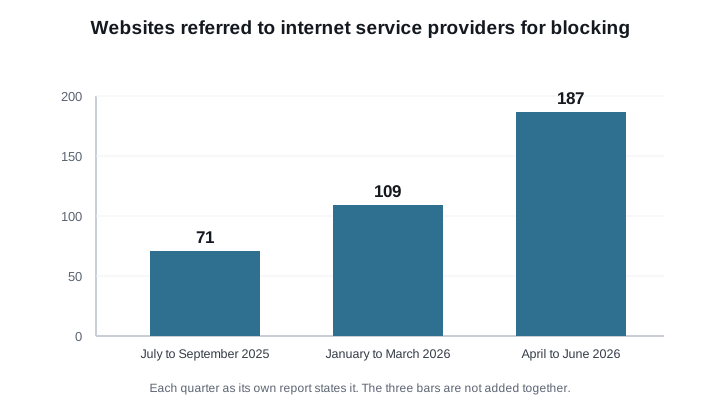
| Quarter | Enquiries and complaints | Investigations | Formal warnings | Websites referred for blocking | Claim |
|---|---|---|---|---|---|
| July to September 2025 | 411 enquiries, 350 valid | 29 investigations into 30 sites | 20 | 71 | 46 |
| January to March 2026 | 422 enquiries, 366 valid | 25 investigations into 60 sites | 13 | 109 | 45 |
| April to June 2026 | 465 enquiries, 417 valid (90 per cent) | 30 investigations into 76 sites, breaches in 27, 56 findings | 18 | 187 | 42, 43, 44 |
Where the consumer is left without a remedy
This section is the one that a reader should read twice. The enforcement record above shows a regulator that is active. It does not show a regulator that can get a customer's money back, and the distinction matters enormously for anyone considering an online casino.
Start with what a complaint to ACMA is. It is a regulatory complaint, not a claim (claim 156). A reader who reports a site to ACMA is giving the regulator information it may act on. They are not starting a process that will return their deposit, their winnings or their losses. The regulator's toolkit under Part 8 is civil and administrative, not compensatory (claim 28).
The official position on recourse is candid. ACMA has said that winnings may not be honoured, that consumers have little or no recourse, and that these services do not have the customer protections expected in Australia (claim 37). It has also said directly that consumers have little or no recourse (claim 159). The Commonwealth made a similar point in 2017, when it said there is limited legal recourse (claim 160).
The complaints route that does work works only for licensed operators (claim 161). That is the crux. For a service that holds an Australian licence, there is a supervisory relationship between the operator and the regulator, and a complaint can go through that relationship. An online casino, as established above, is not on the licensed side of that line. So the route that works is not open.
What about general consumer law. The Australian Consumer Law is stated to apply to gambling businesses (claim 162). But no source reached for this page says whether or how the ACL is enforced against an offshore operator (claim 163). A page may not tell a reader that they have ACL rights against an offshore casino, and may not tell them they have none. The accurate statement is that the question is undetermined in any source that could be read.
What about alternative dispute resolution. No Australian ADR scheme, ombudsman or arbitration body covering online gambling was located (claim 164). That is the absence that matters most to a dissatisfied customer, because ADR is normally where a small consumer dispute goes when the two parties cannot agree. Without it, a disagreement with an offshore casino about a withdrawal has no obvious Australian forum.
Finally, enforceability of the agreement itself. Whether an agreement with an offshore casino is enforceable stays open on the sources reached (claim 165). That is a legal question that has not been settled in any publication this page could verify, and this page does not settle it.
The overall picture is therefore this. The regulator enforces against providers. The offences are written about the provider; no customer offence provision was found; but playing is not therefore without cost (claim 9). The customer is not the target of the law, but neither is the customer given a route to recover. BetStop's own route for an online casino complaint is ACMA (claim 158), and ACMA has said plainly that consumers have little or no recourse (claim 159). A reader who wants the self-exclusion side of this should read Knowing when to stop.
One further point belongs here rather than in the enforcement section. Section 15AA(1) is a separate offence for regulated services that can be licensed; 15AA is the licence route, and online casino is not on it (claim 13). A State or Territory licence cannot authorise an online casino served to a person at home. Section 15 applies regardless of any licence, and s 15AA applies to a different closed class that does not include online casino (claim 15). This closes off the idea that a reader might see a casino brand with some kind of Australian-looking licence and assume the picture changes. It does not.
Why "best" is a question of terms, not of reputation
Return to the word in the heading. Once the legal position and the enforcement record are understood, best stops being a question about which operator is superior and becomes a question about what a reader is actually measuring. In this market, the only things that can be measured from public sources are the statutory position of the service, the terms of any offer, and the published enforcement record. None of the three supports a ranking by quality.
The statutory position is a yes or no. An online casino served to a person at home is a prohibited service, and no Australian licence exists for it (claim 5). The definitions are in s 4(e), s 5(1) and s 5(3) (claims 1, 2, 3). The regulated category in s 8E(1) does not include online casino (claim 14). The only gaming exclusion is place-based (claim 4). There is nothing here to rank, only a category to recognise.
The terms of an offer are comparable but not rankable. A wagering requirement of one number can be set against another. A withdrawal limit can be set against another. A maximum bet clause can be read. But comparing two clauses does not produce a quality score, and the comparison changes depending on what the reader values. Two readers can read the same two offers and reasonably reach different conclusions about which suits them. That is not a ranking; it is a choice, and it belongs to the reader.
The enforcement record is a record of what the regulator did. It shows investigations, warnings and blocking referrals. It does not show which operator is best, because the regulator does not grade operators and publishes no rating of any operator (claim 52). It also does not show that a site which has never appeared in an enforcement report is therefore better. An absence from the published record is not a clean bill of health; it is an absence.
So when a reader asks for the best Australian online casino, the honest reply is that the question, as phrased, cannot be answered from anything a reader could check. What can be answered is a set of narrower questions. Is the service of a kind that Australian law prohibits? What do its terms actually say? What does the published enforcement record show about this market? What happens if the reader has a dispute, and where would it go? The four branches of this hub are those narrower questions, and the pages linked from this one take them one at a time.
That is not a disappointing answer. It is a more useful one, because it replaces a ranking nobody can source with a method the reader can apply. The method is the point of this page.
Practical reading before you open any account
For a reader who has got this far and still intends to look at offers, here is what the rest of this hub asks them to do first.
Read the terms of any offer before the deposit, not after. The clauses that change the arithmetic most are the wagering requirement, the time limit, the maximum bet while the requirement is live, the conversion cap, and the list of games that count. Reading the offers sets out how those clauses are normally worded. Compare the clauses directly rather than relying on a headline percentage.
Check whether the service is one that Australian law prohibits. An online casino served to a person at home is prohibited, and no Australian licence exists for online casino (claim 5). ACMA describes the category the same way (claim 17). If a brand presents itself as Australian, that presentation is worth checking against the statutory definitions rather than against the brand's own wording.
Check the banking clauses for credit cards and crypto. The ban on those methods is the subject of a reported very high level of compliance (claim 41), and a service that still describes them should be read with that in mind.
Understand what recourse exists if something goes wrong. A complaint to ACMA is a regulatory complaint, not a claim (claim 156). Winnings may not be honoured, and consumers have little or no recourse (claim 37). The complaints route that works works only for licensed operators (claim 161). No Australian ADR scheme covering online gambling was located (claim 164). None of this is a reason to do anything in particular; it is information a reader should hold before deciding.
Use the self-exclusion tools if the question is about control rather than about which offer to take. Knowing when to stop collects them. And if the reader has seen a brand advertise that it is not on BetStop, the branch on Casinos not on BetStop explains why that is not a selling point.
The four branches, taken in order, are the substance of this hub. This page is the front door. Each branch is one question, answered from public sources, with no ranking anywhere.
Questions readers ask about this page
Licensing note
There is no Australian licence for an online casino served to a person at home. The prohibited category is set by s 5(1) of the Interactive Gambling Act (claim 2), the excluded categories are a closed list in s 5(3) (claim 3), and the only gaming exclusion is place-based (claim 4). Section 15AA(1) is a separate offence for regulated services that can be licensed, and that licence route does not include online casino (claim 13). A State or Territory licence cannot authorise an online casino served to a person at home; s 15 applies regardless of any licence, and s 15AA applies to a different closed class that does not include online casino (claim 15). ACMA lists banned services as online casinos, in-play sports betting, sports betting services without an Australian licence, and betting on the outcome of a lottery (claim 16), and describes online casinos that provide slots, roulette, poker and other casino games as prohibited in Australia (claim 17). No ACMA page publishes a register of offshore operators or a rating of any operator (claim 52), and no provider count could be read (claim 53).
Where to go next
- Casinos not on BetStop - what the national self-exclusion register covers, what it does not, and why absence from it is not a selling point.
- Online casino no verification withdrawal Australia - what light verification means in a market ACMA says gives consumers little or no recourse.
- New online casino Australia - what is actually new about a new brand and what a reader can check.
- Top 10 online casino Australia real money - why a top ten list cannot be sourced for this market and what to compare instead.
- Australian online pokies - the game category most often searched for, and where it sits in the statutory definition.
- Minimum deposit casino Australia - deposit minimums as a stated term a reader can find and compare.
- Knowing when to stop - the self-exclusion and control tools, including BetStop, in one place.
- How this site is paid - how placements are sold and marked, and what paid placement does and does not mean.
- Reading the offers - how bonus clauses are normally worded and which lines change the arithmetic most.
- Terms and conditions of use - the terms that govern this site itself.