Mobile casino Australia
Before you compare a single mobile casino, assume this: whichever brand you open in a phone browser, the service is a prohibited interactive gambling service under section 5(1) of the Interactive Gambling Act 2001 if it is offered in the course of a business to customers using an internet carriage service, which is the figure the rest of this page works from and the assumption every comparison below rests on.
The Australian mobile casino market is a market of offers rather than of licences, because the product itself sits outside the categories the Act permits, and the commercial arrangements behind the brands you see are advertising and referral arrangements rather than anything a regulator here supervises. That changes what a comparison page can usefully do. It cannot rank products on safety, because the safety architecture a player might expect is not present, and it cannot vouch for a payout, because nothing in Australian law stands behind one. What it can do is set out how the statutory description applies to a phone session, and how this site is paid for showing you the names that follow, which you can read at How this site is paid.
Offers in this block are advertising. Placement and order are paid. The wording inside each entry is supplied by the operator and reproduced without alteration. Terms are set by the operator.
- welcome package 100% up to 4000 aud + 1200 fs + bonus game
- first deposit bonus 100% up to 1000 aud + bonus game + 300 fs
- second deposit bonus 100% up to 1000 aud + 300 fs
- first deposit bonus 120% up to 5000 aud + instant bonus round + 250 fs
- second deposit bonus 100% up to 2500 aud + 250 fs
- third deposit bonus 80% up to 2500aud + 250 fs
- welcome package 600% up to $4800 + 255 free spins
- daily cashback 10%
- weekly rakeback bonus! the genie grants your wishes!
- CRYPTO WELCOME BONUS 140% UP TO 1,600 USDT +140 FS
- CASINO WELCOME PACK 570% Up To $11,400 + 270 FS
- VIP WELCOME PACK 850% UP TO $27,000
- starting bonus package up to 5200 au$ + instant bonus round + 1500 free spins
- first deposit bonus 100% up to au$300 + instant bonus round + 100 free spins
- highroller bonus 100% up to au$3,000
Why a phone session changes nothing
A mobile browser session and a native application both reach the operator over an internet carriage service. That single fact does most of the work on this page. Section 5(1) of the Interactive Gambling Act 2001 describes a prohibited interactive gambling service as a gambling service provided in the course of a business to customers using an internet carriage service, and the medium through which those customers reach it does not alter that description. A smaller screen, a touch interface, a saved login, a persistent session that survives a train trip: none of these is a legal category, and none of them moves the service into or out of the prohibition. The device is a delivery mechanism. The statute looks at the service and at the carriage, not at the handset.
It follows that the mobile framing is a marketing frame more than a legal one. Operators design for phones because phones are where the audience is, and because a session that opens in two taps is a session that happens more often. That is a commercial observation, not a statutory one, and it should be read that way. If you have read a page describing a mobile casino as a different kind of product from a desktop one, the difference being described is one of user experience, not of regulatory treatment. The same description in section 5(1) applies whether the customer is on a laptop at a kitchen table or on a phone in a car park.
For a reader, the practical consequence is that the device asks more of your judgement, not less. A phone session is shorter, more frequent, more likely to happen in a spare moment, and often funded through a payment method already stored on the device. None of that is an argument about legality. It is an argument about attention. The medium removes friction, and friction is one of the few things that used to slow a decision down. When you read the comparison below, read it as a list of commercial offers rather than as a list of approved products, because there is no approved product in this category to list.
There is also a documentation point worth stating plainly. Where this page describes a statutory provision, it describes the provision. Where it describes an offer, it describes the offer as the operator publishes it. The two are kept apart deliberately, because combining them would imply a relationship that does not exist. No brand named on this page holds an Australian licence for the product, and no statutory provision on this page was written with any particular brand in mind.
What section 5(1) actually describes
Section 4 of the Act defines a gambling service, and paragraph (e) of that definition brings in a service for the playing of a game of chance or a game of mixed chance and skill for money. That is a broad definition, and it is meant to be. Read alone, it would capture a great deal of ordinary activity. Read with section 5, it does specific work: section 5(1) takes a gambling service, adds the conditions that it is provided in the course of a business and to customers using an internet carriage service, and describes the result as a prohibited interactive gambling service. Each element matters, and each is worth reading slowly.
In the course of a business is a condition about character rather than size. A service offered commercially, repeatedly, as an enterprise, meets it. To customers using an internet carriage service is a condition about delivery. Anyone reaching a service through a browser or an application on a phone is using an internet carriage service to do so. When both conditions attach to a gambling service, section 5(1) describes the result. There is no further test about the quality of the site, the currency of the account, or the jurisdiction of the operator. The description is about what the service is and how it reaches people.
Section 5(3) sets out exclusions, and this is where the category of licensed online casino would sit if it existed. It does not. The exclusions cover other things, and none of them carves out an online casino product offered to customers in Australia. The load-bearing point for a reader is therefore simple to state and hard to soften: an online casino played at home falls within the description in section 5(1), nothing in section 5(3) takes it out, and there is no category for a licensed online casino that an operator could apply for and hold. That absence is the whole reason the market looks the way it does.
Section 15(4) speaks to reasonable diligence, and it is relevant to the obligations the Act places on those who provide services, not to anything a player does. The factors in that subsection are directed at what a provider did or failed to do. A reader sitting with a phone in hand is not the subject of that subsection, and this page will not stretch it to say otherwise. What section 15(4) does mean for a reader is that the compliance burden the Act contemplates rests with operators and with the businesses that carry their advertising, which is part of why the offers below are described as commercial propositions rather than as supervised products.
Finally, there is a point about what the statute does not say. It does not publish a ceiling on what a player can be offered, because the framework is built around service provision rather than around consumer entitlement. It does not publish a list of acceptable operators, because there is no licensing pathway to populate such a list. Reading the Act closely produces an accurate picture of a prohibition and a fairly thin picture of anything else, and that thinness is itself information.
Mobile casino comparison
The table below lists brands that market to Australian readers and the terms each publishes for its own welcome offer, wagering requirement, minimum deposit, payout window and payment rails. Every figure is the operator's own published term. Amounts are shown in the currency the brand publishes and are not converted, so a figure in one column is not directly comparable with a figure in another unless the brand itself publishes in the same currency. Where a brand does not publish a term in a form that could be read and checked, the cell reads Check on the operator's own site, which is the honest marker rather than an estimate.
| Brand as written | Welcome offer | Wagering | Minimum deposit | Payout window | Payment rails |
|---|---|---|---|---|---|
| Joe Fortune | Check on the operator's own site | Check on the operator's own site | Check on the operator's own site | Check on the operator's own site | Check on the operator's own site |
| Ignition Casino | Check on the operator's own site | Check on the operator's own site | Check on the operator's own site | Check on the operator's own site | Check on the operator's own site |
| Fair Go Casino | Check on the operator's own site | Check on the operator's own site | Check on the operator's own site | Check on the operator's own site | Check on the operator's own site |
| Ricky Casino | Check on the operator's own site | Check on the operator's own site | Check on the operator's own site | Check on the operator's own site | Check on the operator's own site |
| Uptown Pokies | Check on the operator's own site | Check on the operator's own site | Check on the operator's own site | Check on the operator's own site | Check on the operator's own site |
| Red Stag Casino | Check on the operator's own site | Check on the operator's own site | Check on the operator's own site | Check on the operator's own site | Check on the operator's own site |
| Slotocash | Check on the operator's own site | Check on the operator's own site | Check on the operator's own site | Check on the operator's own site | Check on the operator's own site |
| Golden Euro Casino | Check on the operator's own site | Check on the operator's own site | Check on the operator's own site | Check on the operator's own site | Check on the operator's own site |
| Wildz | Check on the operator's own site | Check on the operator's own site | Check on the operator's own site | Check on the operator's own site | Check on the operator's own site |
| Lucky Nugget Casino | Check on the operator's own site | Check on the operator's own site | Check on the operator's own site | Check on the operator's own site | Check on the operator's own site |
No Australian licence exists for this product. The marker Check on the operator's own site means the brand does not publish that term in a form that could be read and confirmed here, so the only responsible entry is a pointer back to the brand's own published terms.
Reading the table takes a little patience, because the columns answer different questions. A welcome offer is a promotional construct, and its headline figure tells you very little until you have read the wagering attached to it. A wagering requirement is the number of times a promotional balance must be turned over before it converts, and it is the single most consequential term in the row. A minimum deposit tells you the floor of participation. A payout window tells you how long a withdrawal takes once it has been requested, and it says nothing about how long a request takes to be accepted. Payment rails tell you which methods the brand lists, which is a question of convenience rather than of protection.
None of these columns can be checked against a public register, because no public register of licensed Australian online casino operators exists. That is not a gap in this page's research. It is a feature of the statutory position described above. The consequence for a reader is that every cell in the table is a commercial representation made by the brand, and the standard of proof available to you is the brand's own documentation. If a term is not written down on the operator's own site, treat it as not fixed. If it is written down, treat it as the version that applied on the day you read it, since terms change and no one publishes a change log you can audit.
What a reader gives up on a phone
Because there is no Australian licence behind the product, there is no Australian supervisory body holding the operator to a published standard, and that is the first thing a reader gives up. Ordinarily, a licensed product comes with an assumption that someone has looked at the operator's systems, its solvency, its dispute process and its conduct, and that an avenue exists if something goes wrong. That assumption does not transfer here. A deposit made to a brand operating outside the Australian framework is a matter between you and that brand, governed by whatever terms it publishes and whatever jurisdiction it operates from, and there is no Australian regulator whose role it is to intervene on your behalf over a wager.
What a reader cannot hold an operator to is worth enumerating, because the list is longer than the marketing suggests. You cannot hold a brand to an Australian payout standard, because none applies. You cannot hold it to a dispute resolution scheme recognised here, because it is not a member of one. You cannot hold it to a statutory definition of a fair game, because the enforcement machinery that would give that definition teeth is not pointed at this product. You cannot assume a cooling-off arrangement, a self-exclusion register that the operator is obliged to check, or a statutory limit on how much you can deposit in a session. Those protections exist in parts of the Australian gambling landscape. They do not exist here.
The mobile context sharpens each of these. A deposit from a phone often runs through a wallet or a stored card, which means the money can move without a card number being typed. A session often starts from a notification or a saved link, which means the decision to play can be made in a second. A withdrawal request can be made in the same way, and a payout window measured in days can feel much longer when the interface made the deposit feel instant. None of this is a reason to treat the phone as more dangerous as a device. It is a reason to notice that the friction the medium removed was the friction that gave you a moment to think.
There is a further thing given up, and it is subtler: the ability to reason by analogy from a regulated product. A reader who has used a licensed wagering service in Australia knows the shape of the protections and can carry that shape across to a new product. That reasoning does not work here, because the protections are not a lighter version of the familiar ones. They are absent by design. Treating an offshore casino as though it were a licensed wagering operator with a different badge is the most common error a careful reader can make, and it is the error this section is written to prevent.
Reasonable diligence and mobile payments
Section 15(4) of the Act lists factors that go to whether a person took reasonable diligence in relation to an offence. Those factors are framed around what a provider knew or should have known, what systems it ran, and what steps it took. Read carefully, the subsection is about the conduct of the person providing or carrying the service. It is not a provision addressed to a player, and this page will not pretend otherwise. Its relevance here is contextual: it shows that the Act places the compliance question on the supply side, and it shows why a reader should not read a mobile payment rail as though it carried a compliance assurance.
Take the payment rail question on its own terms. A phone offers a short list of methods: a stored card, a wallet, a bank transfer initiated in an app, occasionally a prepaid route. Each works, and each moves money out of your account and into an operator's account in a way you cannot reverse the way you can reverse a mistaken card payment to a shop. A wallet payment, once authorised, is authorised. A bank transfer, once sent, is sent. The rails a brand lists are a convenience comparison and nothing more. This page will not state a data cost figure for any method, because no figure is published that could be verified, and it will not describe app store rules, because those rules are not a statement about the statutory position.
What the payment rail does affect is your own record. A method that produces a clear statement line, a reference and a timestamp gives you something to point at if a withdrawal is disputed. A method that produces a single line with an operator's trading name and no reference gives you much less. That is not a compliance argument. It is a practical one, and it is the strongest reason to prefer a payment route whose documentation you can read afterwards. Since no Australian supervisory body will reconstruct the transaction for you, your own record is the only one that will exist in a form you control.
There is a timing point too. Mobile payment flows tend to confirm quickly and to settle at the speed of the underlying rail. A card authorisation can appear within seconds while a withdrawal through the same card can take days to clear, and nothing in the terms you agreed to obliges the operator to match the two speeds. A reader who notices this asymmetry early is less likely to interpret a slow payout as a fault and more likely to interpret it as the ordinary behaviour of a commercial arrangement with no statutory clock attached to it.
Penalties and what is not published
Where a penalty is expressed in penalty units, the value of the unit changes over time, and the Act's framework converts units into dollars by reference to the unit value in force for the offence. For offences committed on or after 1 July 2026, the penalty unit is $364. For offences committed from 7 November 2024, it was $330. For offences committed from 1 July 2023 up to 6 November 2024, it was $313. Those figures are the unit values, and they are the only dollar figures this page will quote in connection with the penalty framework.
What is not published is equally important. No dollar maximum penalty under section 15 is published in a form that could be quoted here. No source states that a player commits no offence, so this page does not state it either, in either direction. No regulations under section 69A were located, so this page makes no assertion about any agreement being enforceable or unenforceable. No count of offshore operators serving Australia is published anywhere, so this page gives no count and no percentage. Each of those absences is a restraint, and each is deliberate.
The reason for the restraint is simple. A page about a market with no Australian licence is a page where an invented figure would do real damage. A reader who is told that a penalty is a specific dollar amount, or that an agreement is or is not enforceable, or that a player is or is not exposed, may act on that statement. Since none of those statements can be sourced, none of them appears. What appears instead is the unit value, which is a published figure, and the statutory description of the conduct, which is a published text. Everything else is marked as unpublished.
It also helps to be clear about direction. The penalty framework in the Act is directed at those who provide or carry prohibited services. A reader comparing mobile offers is not the addressee of that framework, and this page does not suggest otherwise. Nor does it suggest that a reader has or has not got rights under the Australian Consumer Law in relation to any transaction described here. The honest statement is that the consumer law question depends on facts this page does not have, and that the penalty framework is a supply-side matter. Both statements are narrow, and both are accurate.
Referrals and blocking
The enforcement picture that does exist in Australia runs largely through referral and blocking rather than through licensing. The regulator refers websites to internet service providers for blocking, and it reports the referrals it makes each quarter. The figures are reported per quarter rather than cumulatively, which means the right way to read them is as a series of separate counts rather than as a running total. That is a small point of arithmetic with a large consequence for how the numbers should be described.
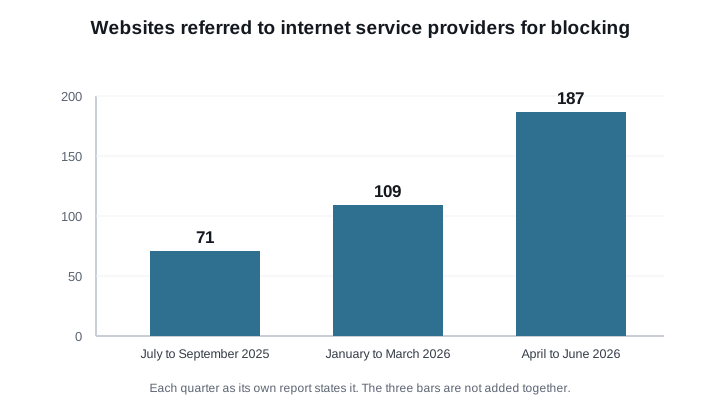
Blocking is a different mechanism from licensing, and the difference matters to a reader on a phone. A blocked site is a site a provider has been asked not to carry, which is an instruction about carriage rather than a finding about the operator. It does not establish that the operator has done anything in particular, and it does not establish anything about a reader's position. What it does show is that the enforcement route available in this area runs through the carriage layer, which is consistent with the shape of section 5(1) described above. The prohibition is about a service reaching customers over an internet carriage service, so the intervention that follows is about that carriage.
For a reader, the practical takeaway is that a site being reachable tells you nothing about its standing, and a site being unreachable tells you nothing about a transaction you may already have made. Reachability is a network fact. Standing is a commercial and statutory question, and in this category the statutory answer is the one given above: no Australian licence exists for the product. A page that presents a working login as evidence of legitimacy has confused the two.
A practical checklist before you tap
Start with the terms, not the offer. Open the brand's own published terms and find the wagering requirement, the minimum deposit, the payout window and the payment rails. If a term is not there, treat it as unset. If it is there, note the date you read it. This takes a few minutes and it converts a headline into something you can actually evaluate. It also tells you whether the brand documents its own product to a standard you find acceptable, which is a useful signal even though it carries no regulatory weight.
Then check the payment route against your own record keeping. Choose a method whose statement line you can read, and keep the confirmation. Note the amount in Australian dollars and note that this page quotes AUD throughout. If a brand publishes in another currency, the figure you see is in that currency and is not converted here, so a direct comparison with an AUD figure is not valid. That is a small discipline with a large effect on how much you can reconstruct later.
Third, decide in advance what you are willing to put at stake, and write it down somewhere that is not the app. The absence of a statutory deposit limit or a self-exclusion register that the operator must check means the limit has to come from you. A number chosen before a session is a better number than one chosen during it. This is not a legal point and it is not a promise about outcomes. It is the only control in the list that sits entirely on your side of the screen.
Fourth, read the statutory description once and keep it in mind. Section 5(1) plus section 5(3) produces the position that an online casino played at home is a prohibited interactive gambling service and that no licensed category for it exists. Everything else on this page follows from that, including the absence of a public register, the absence of a published dollar maximum under section 15, and the absence of any published count of offshore operators. When an offer looks unusually generous, the generous part is a commercial term and the statutory position is unchanged.
A quick way to see what a session actually costs is to add the deposit to whatever you would have spent on the same hours elsewhere, and to compare the total with what you can afford to lose without adjusting anything else in the month. Enter your own figures; the result is a sum, not a projection.
Your total will appear here.
The calculator does one thing: it adds two numbers you supply. It does not model returns, it does not project a balance, and it does not estimate a data cost, because no data cost figure is published that could be verified. Treat the total as a budget line rather than a forecast. If the total is a number you would notice in a month, that is the information you needed, and it is available before the first deposit rather than after it.
- Does using a phone instead of a laptop change the position?
- No. A mobile browser session and an application both use an internet carriage service, so the medium does not change the analysis under section 5(1). The statute looks at the service and at the carriage, not at the handset.
- Is there an Australian licence for an online casino?
- There is no category for a licensed online casino in the framework described on this page. An online casino played at home falls within the description in section 5(1), and nothing in section 5(3) takes it out.
- Why does the table say check on the operator's own site?
- Because that brand does not publish the term in a form that could be read and confirmed here. The marker is an honest entry rather than an estimate, and it points you back to the brand's own published terms.
- Is the welcome offer figure comparable across brands?
- Only with care. Each figure is the operator's own published term, amounts stay in the currency the brand publishes, and nothing is converted here, so a figure in one currency is not directly comparable with a figure in another.
- What does a wagering requirement mean?
- It is the number of times a promotional balance must be turned over before it converts. It is the most consequential term in a row, and it is worth reading before the headline figure.
- Can I rely on a payout window as a promise?
- A payout window is the operator's own published term and it describes a window, not a guarantee. Nothing in Australian law stands behind it for this product, and no Australian supervisory body will reconstruct the transaction for you.
- Is a dollar maximum penalty published under section 15?
- No dollar maximum penalty under section 15 is published. The published figures are the penalty unit values: $364 for offences on or after 1 July 2026, $330 from 7 November 2024, and $313 from 1 July 2023 to 6 November 2024.
- Are the blocking figures cumulative?
- No. Each quarter's report states its own figure, and no cumulative total is published anywhere that could be read. The three bars are separate counts and are not added together.
Licensing note
No Australian licence exists for the product described on this page. Section 5(1) of the Interactive Gambling Act 2001 describes a prohibited interactive gambling service as a gambling service provided in the course of a business to customers using an internet carriage service, and section 5(3) contains no exclusion that would take an online casino played at home out of that description. There is no category for a licensed online casino that an operator could apply for and hold. Every brand named on this page is a commercial operator publishing its own terms, and none of those terms is supervised by an Australian regulator. The penalty unit values quoted are $364 for offences committed on or after 1 July 2026, $330 from 7 November 2024, and $313 from 1 July 2023 to 6 November 2024. No dollar maximum penalty under section 15 is published, no source states that a player commits no offence, no regulations under section 69A were located, and no count of offshore operators serving Australia is published. Nothing on this page states that any agreement is or is not enforceable, and nothing on this page states that a reader has or has not got rights under the Australian Consumer Law.
Where to go next
- Australian online pokies how the same statutory description applies to the pokies category and what the offers look like.
- Live casino Australia the dealer-led format, its bandwidth demands on a phone, and where the terms differ.
- Online slots Australia the slots market read through published terms rather than through product claims.
- High roller casino Australia larger limits and what a bigger deposit changes, and does not change, about the position.
- Apple Pay casino the wallet route, what it records, and why a fast confirmation is not a protection.
- Google Pay casino the second wallet route and the documentation it leaves behind for your own records.
- Reading the offers how to work through wagering, minimum deposits and payout windows without being misled by a headline.
- How this site is paid the commercial arrangements behind the names on this page, stated plainly.