New online casino Australia
Treat any "$1 minimum deposit, 100 free spins" opener you see this month as a marketing budget, not a house edge in your favour, and assume you will stake the full bonus at least once before you see a withdrawal, because that single assumption decides whether a new brand is worth your time. Everything below is written for a reader holding AUD.
The Australian market rewards a clear head. New brands arrive with louder welcome offers than established ones because they are buying attention, and attention in this market is expensive. What follows is a market view of how those offers are structured, how the terms behind them are meant to be read, and where the statutory position sits underneath all of it. Our commercial arrangements with operators we list are set out on How this site is paid, and reading that first will tell you what a placement here does and does not mean.
Offers in this block are advertising. Placement and order are paid. The wording inside each entry is supplied by the operator and reproduced without alteration. Terms are set by the operator.
- welcome package 100% up to 4000 aud + 1200 fs + bonus game
- first deposit bonus 100% up to 1000 aud + bonus game + 300 fs
- second deposit bonus 100% up to 1000 aud + 300 fs
- first deposit bonus 120% up to 5000 aud + instant bonus round + 250 fs
- second deposit bonus 100% up to 2500 aud + 250 fs
- third deposit bonus 80% up to 2500aud + 250 fs
- welcome package 600% up to $4800 + 255 free spins
- daily cashback 10%
- weekly rakeback bonus! the genie grants your wishes!
- CRYPTO WELCOME BONUS 140% UP TO 1,600 USDT +140 FS
- CASINO WELCOME PACK 570% Up To $11,400 + 270 FS
- VIP WELCOME PACK 850% UP TO $27,000
- starting bonus package up to 5200 au$ + instant bonus round + 1500 free spins
- first deposit bonus 100% up to au$300 + instant bonus round + 100 free spins
- highroller bonus 100% up to au$3,000
What newness changes and what it does not
A new operator arrives in this market with two things: a marketing budget and a set of terms. The budget is visible, because it is spent in front of you. The terms are less visible, because they sit behind a link you have to choose to open. Readers tend to weigh the first far more heavily than the second, which is precisely why new entrants lead with the first. None of that is a criticism of any particular brand. It is a description of how a crowded market allocates attention, and it should shape how you read any launch offer you encounter this month or next.
What newness genuinely changes is the shape of the offer: a new brand is more likely to waive a minimum deposit, to raise a match percentage, or to attach a large spin bundle to a first deposit. What newness does not change is the arithmetic underneath. A match percentage is a multiplier on a deposit you have to make; a spin bundle is a number of spins whose value depends on the stake per spin, the wagering contribution of the game they land on, and the time limit attached. Those three variables decide more about the outcome than the headline ever does, and they are identical in structure whether the brand launched last week or a decade ago.
There is a statutory layer that newness also does not touch. A product offered to a player physically in Australia either falls inside a prohibited category or it does not, and the categories are defined by legislation, not by the age of the brand offering them. A newly launched site has no route into a category that does not exist for anyone. When a launch banner suggests otherwise, by implication or by silence, the banner is doing marketing work rather than describing a legal position. That distinction is the single most useful thing to carry into the rest of this page.
It is also worth separating the operator from the product. An operator may be a real business with real staff, real payment processing and real customer support, and still offer a product that sits inside a prohibited category for players in this jurisdiction. Those two facts are not in tension. They coexist, and reading them together is more accurate than collapsing one into the other. The sections below take each in turn: the offer mechanics first, because that is what you act on, and the statutory position second, because that is what frames the choice.
Reading a welcome offer before you deposit
A welcome offer is a contract of sorts, and like any contract it is worth reading the parts that cost you something. In practice the parts that cost you something are the wagering requirement, the maximum bet while a bonus is active, the game contribution table, the time limit, and the maximum conversion from a bonus to withdrawable cash. Each of these appears in the general terms or the bonus terms rather than on the landing page, and each of them can turn a headline figure into something much smaller. Reading them before you deposit costs ten minutes. Reading them after costs the deposit.
Start with the wagering requirement, because it is the one that most changes the arithmetic. A requirement expressed as a multiple of the bonus means you must stake several times the bonus amount before any of it converts. A requirement expressed as a multiple of the deposit plus the bonus means you must stake several times a larger number. The difference between the two conventions is not cosmetic; on the same headline figure it can roughly double the total stake required. Any offer that states a multiple without saying what it applies to has not told you the most important thing about it, and the honest response to that is to look for the answer in the terms or to move on.
Then read the game contribution table. Most offers assign different percentages to different categories, and the categories that contribute least are often the ones players gravitate to first. A contribution figure below one hundred per cent means you are staking more to satisfy the same requirement, and the effective requirement rises accordingly. The maximum bet clause sits next to it and is frequently the reason a bonus is voided: placing a single bet above the cap while a bonus is active can forfeit the bonus and any winnings attached to it, and the cap can be low in absolute terms. Neither clause is hidden, but both are easy to skip when the headline is large.
Time limits and maximum conversion come last and matter just as much. A short expiry window compresses the stake you have to place into a smaller number of sessions, which pushes play toward higher variance rather than steady grinding. A maximum conversion cap means that even a successful run converts only up to a ceiling, with the remainder removed. Neither of these is unreasonable in itself, and plenty of readers accept both knowingly. The point is to know it before rather than after. An offer you understand and accept is a different proposition from one you discover halfway through.
Finally, treat the minimum deposit as a floor rather than a target. A very low minimum deposit is a genuine convenience for a reader who wants to test a site's interface, support and withdrawal process with a small amount at stake. It is not evidence that the offer is generous, and it is not a reason to deposit more than you had planned. The figure the reader acts on is the total you are willing to place at stake across the whole exercise, not the amount the banner asks for at the door. Decide the first number, then check whether the offer fits inside it. If it does not, the offer is not for you this month, and that is a complete and satisfactory outcome.
The statutory position for online casino play
The Interactive Gambling Act 2001 defines a gambling service at section 4, and paragraph (e) of that definition brings services covered by the Act within its scope. Section 5(1) then defines a prohibited interactive gambling service, and the definition turns on a set of categories rather than on the identity or reputation of the operator. Section 5(3) sets out a closed list of exclusions from that definition, and the list is enumerated rather than illustrative. That structure matters: a service either fits an exclusion on the list or it does not, and there is no general discretion to add one for a well-run business or a newly launched brand.
Section 8B(1) addresses gaming specifically, and the only gaming exclusion it provides is place-based. The subsection lists the requirements that must be met for that exclusion to apply, and those requirements are geographic and physical in character. Read together, sections 5(3) and 8B(1) leave no category for a licensed online casino serving a player at home. The prohibition operates on the product as delivered to the player's location, and the delivery method is the thing the provisions describe. Online casino play at home is therefore prohibited, it is excluded by nothing in section 5(3), and there is no category in the Act under which a licensed online casino could be authorised to offer that product to a player in Australia.
That conclusion is structural rather than particular. It does not depend on which operator is offering the product, how long it has operated, where it is incorporated, or what licences it holds elsewhere. A new entrant changes nothing about it, because the analysis runs from the product to the player's location and stops there. Newness is not a licence, and the absence of an Australian licence for this product is a feature of the statutory scheme rather than a gap that a sufficiently well-capitalised newcomer might fill. Readers sometimes infer from a polished launch that a regulatory pathway must exist. No such pathway is described in the provisions above.
What the Act does not do is equally worth stating plainly, because a great deal of commentary fills the silence with assertions. No dollar maximum penalty under section 15 is published, so none can be quoted. No source states that a player commits no offence, so that cannot be asserted either. No regulations under section 69A have been located, and nothing here should be read as saying whether any particular agreement is or is not enforceable. No count of offshore operators serving Australia is published, so no figure for that can be given. Where the published record is silent, this page is silent too. Filling those gaps would be invention, and invention is the opposite of what a reader deciding where to spend money needs.
The penalty unit figures are published and can be stated. A penalty unit is $364 for offences committed on or after 1 July 2026. It was $330 from 7 November 2024, and $313 from 1 July 2023 until 6 November 2024. Those figures tell you how penalties are calculated where a penalty is expressed in units. They do not tell you what any particular contravention attracts, because the published record does not supply that. The distinction between a published rate and a published maximum is one readers routinely blur, and it is worth keeping sharp. A rate is a multiplier. A maximum is a ceiling. Only one of the two is in the public record here.
Brands and their published terms
The table below collects what each brand publishes about its welcome offer, wagering, minimum deposit, payout window and payment rails. Figures are each operator's own published terms, and amounts stay in the currency the brand publishes them in rather than being converted. Where a brand does not publish a figure in a form that can be stated, the cell says so plainly rather than guessing. A missing cell is information: it tells you that the term is either absent from the public pages or expressed too loosely to record, and that you will need to check on the operator's own site before relying on it.
| Brand as written | Welcome offer | Wagering | Minimum deposit | Payout window | Payment rails |
|---|---|---|---|---|---|
| Joe Fortune | Check on the operator's own site | Check on the operator's own site | Check on the operator's own site | Check on the operator's own site | Check on the operator's own site |
| Ignition Casino | Check on the operator's own site | Check on the operator's own site | Check on the operator's own site | Check on the operator's own site | Check on the operator's own site |
| Fair Go Casino | Check on the operator's own site | Check on the operator's own site | Check on the operator's own site | Check on the operator's own site | Check on the operator's own site |
| Ricky Casino | Check on the operator's own site | Check on the operator's own site | Check on the operator's own site | Check on the operator's own site | Check on the operator's own site |
| Uptown Pokies | Check on the operator's own site | Check on the operator's own site | Check on the operator's own site | Check on the operator's own site | Check on the operator's own site |
| Red Stag Casino | Check on the operator's own site | Check on the operator's own site | Check on the operator's own site | Check on the operator's own site | Check on the operator's own site |
| Slotocash | Check on the operator's own site | Check on the operator's own site | Check on the operator's own site | Check on the operator's own site | Check on the operator's own site |
| Golden Euro Casino | Check on the operator's own site | Check on the operator's own site | Check on the operator's own site | Check on the operator's own site | Check on the operator's own site |
| Wildz | Check on the operator's own site | Check on the operator's own site | Check on the operator's own site | Check on the operator's own site | Check on the operator's own site |
| Lucky Nugget Casino | Check on the operator's own site | Check on the operator's own site | Check on the operator's own site | Check on the operator's own site | Check on the operator's own site |
No Australian licence exists for this product. Any row marked with that placeholder is a term the operator has not published in a form that can be recorded here, and it should be verified directly before you deposit.
The reason so many cells read as placeholders is not laziness on the operator side. Welcome terms change often, payout windows are frequently expressed as ranges with stated exceptions, and payment rails depend on the customer's own banking arrangements. A figure captured here on a Tuesday may be stale by the following week, and a stale figure is worse than an absent one because it looks authoritative. Recording the absence honestly keeps the table useful as a checklist of what to confirm rather than a set of numbers to trust. Use it to see which brands you want to investigate, then do the investigating on the brand's own pages.
Two habits make the table more useful. First, read the payout window as a statement about processing rather than about arrival: a window usually describes how long the operator takes to approve a request, after which your bank or payment provider adds its own time. Second, read the payment rails as a list of availability rather than a recommendation, because the rail that suits you depends on your own accounts, not on the brand's preferences. Neither habit requires any technical knowledge, and both reduce the chance of a surprise at the point where it matters most, which is withdrawal.
The cost of a bonus, worked through
The calculator below estimates the total stake a welcome bonus requires before any of it converts, using three inputs: the deposit, the bonus amount, and the wagering multiple. It also shows the same total expressed as a multiple of the deposit, which is the figure most readers find easier to hold in their heads. The estimate assumes one hundred per cent contribution and a requirement applied to deposit plus bonus, so it is a floor rather than a forecast. Adjust the inputs to match the terms you are actually reading, and if the terms apply the multiple to the bonus alone, set the deposit figure to zero in your mental model and read the resulting line as the smallest version of the requirement.
Enter the deposit, the bonus and the wagering multiple. The output states the total stake required under a deposit-plus-bonus requirement at one hundred per cent contribution, and the same total as a multiple of the deposit.
Total stake required: 3,000 AUD
As a multiple of the deposit: 60 times
Estimate only. Contribution below one hundred per cent, a maximum bet cap, an expiry window or a conversion ceiling will each raise the real requirement.
Read the output as a stake, not a loss. Placing 3,000 AUD at stake across a bonus does not mean losing 3,000 AUD; it means putting that amount through the machine, with the expected result depending on the games you choose and the house edge they carry. What the figure tells you is the volume of play the terms ask for, and volume is the variable that turns a small edge into a meaningful expected cost over time. A reader who plays a hundred hands for fun is having a different experience from a reader who plays thousands to clear a requirement. The calculator exists to make that difference visible before you commit rather than after.
The ratio line is the one to carry with you when comparing offers. An offer with a large headline bonus and a high multiple can require more stake than a smaller bonus with a modest multiple, and the headline will never tell you that. Once you are reading every offer in the same unit, which is total stake as a multiple of your own deposit, the comparison becomes straightforward and the marketing language loses most of its power. Our longer note on this method is on The margin we assume, which sets out the assumptions behind the estimate and the circumstances in which reality will differ.
Two refinements are worth applying by hand on top of the calculation. If the contribution table assigns less than one hundred per cent to the games you intend to play, divide the total stake by that percentage to see the real requirement. If a maximum bet cap is low enough to slow your progress, multiply the number of sessions you will need accordingly, and check that the expiry window has room for them. Neither refinement needs a spreadsheet. Both catch the cases where a bonus that looks workable on the first line becomes a commitment you would not have chosen.
Referrals and blocking
Blocking sits alongside the statutory position as a practical mechanism, and it is worth understanding what it does and does not represent. A referral to an internet service provider asks the provider to take steps against access to a site. It is an administrative action taken against access, and it is recorded in the reports the regulator publishes each quarter. Those reports are the only place where the numbers below come from, and each figure is the figure that report states for its own period, not a running total.
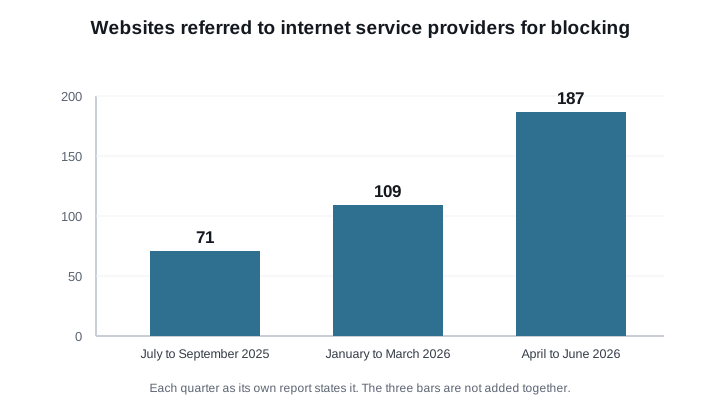
The three bars are deliberately not summed. A cumulative total would be a figure this page invented by addition, and no such total is published anywhere that could be read. The figure that circulates in commentary as a running total is a news report rather than a regulator's own number, which is a different kind of source and should be treated as such. The distinction matters because a cumulative figure implies a stock of blocked sites, while quarterly figures describe activity in a period. Those are different claims, and only one of them is in the published record.
What the figures do not tell you is whether any particular site is reachable from your connection on any particular day. Blocking operates at the level of access, it is implemented by providers, and it is not a statement about the legality of play for an individual. This page does not make statements of that kind, and readers looking for one should note the silence deliberately: no source states that a player commits no offence, so neither the affirmative nor its opposite can be asserted here. What can be said is that access and legal position are separate questions, and treating a working connection as evidence of a legal position is a category error.
For readers who want to understand the practical mechanics of restricting their own access, our note on Casinos not on BetStop covers how self-exclusion registers interact with the sites people actually reach, and where the gaps sit. That page is about managing your own arrangements rather than about the statutory position, and the two are best read as separate layers. The register is a tool you control; the Act is a frame you do not. Keeping the layers apart makes both easier to use.
A practical checklist before your first deposit
Decide your total stake before you look at any offer, and write it down. The figure should be an amount you are content to place through a site without it affecting anything else in your month. Once the number exists, every offer can be measured against it using the calculator above. Offers that do not fit are set aside without further thought, which is faster and calmer than weighing each one on its own terms. The discipline is not about restraint for its own sake; it is about making the decision once, in a quiet moment, rather than repeatedly under the influence of a landing page.
Then read the five clauses that cost you something: the wagering multiple and what it applies to, the game contribution table, the maximum bet cap, the expiry window, and the maximum conversion. If any of the five is not stated in a form you can find, treat that as a term you have not yet read rather than a term that does not exist. An operator with a well-organised terms page will make all five easy to locate, and the ease of locating them is itself a useful signal about how the rest of the relationship will go. Ten minutes on the terms page is the cheapest due diligence available.
Confirm the withdrawal side before you deposit, not after. Check the payout window, the payment rails available to you, and any verification steps the operator requires at the point of withdrawal. Verification requirements are the most common cause of delay, and they are usually stated somewhere in the account or withdrawal pages. Knowing what you will be asked to provide, and having it ready, removes the friction at exactly the moment when friction is most irritating. It also tests whether the operator's published information is accurate and current, which is worth knowing early.
Keep a simple record of what you deposit, what you stake and what you withdraw, and review it at the end of each month. The record does not need to be elaborate; a note of three figures per session is enough. Its purpose is to keep your own experience as the primary evidence rather than the impressions formed during play, which are systematically unreliable on both the winning and the losing side. Readers who keep the record tend to describe their play in terms of stake and outcome. Readers who do not tend to describe it in terms of how it felt, and the two descriptions diverge quickly.
Finally, treat the statutory position as context rather than as a permission slip. The sections above set out what the published record says and, just as importantly, where it says nothing. Nothing on this page states that any particular course of action is lawful or unlawful for a player, and nothing states whether any agreement is or is not enforceable; those questions are outside what the published material supports. What the page does give you is the structure of the offers, a method for costing them, and an honest account of the legislative frame. Use the first two, and hold the third in mind when a banner implies more than it can.
- Does a newly launched casino change anything about the statutory position for Australian players?
- No. The position runs from the product to the player's location, and it does not depend on the age of the brand, where it is incorporated, or what licences it holds elsewhere. Newness is not a licence, and there is no category in the Act under which a licensed online casino could offer this product to a player at home.
- What does section 5(1) actually define?
- Section 5(1) defines a prohibited interactive gambling service. The definition turns on a set of categories rather than on the identity or reputation of the operator offering the service.
- Is the list of exclusions in section 5(3) open or closed?
- It is a closed list. The exclusions are enumerated rather than illustrative, so a service either fits an exclusion on the list or it does not, and there is no general discretion to add one for a well-run or newly launched business.
- What does section 8B(1) provide for gaming?
- The only gaming exclusion it provides is place-based, and the subsection lists the requirements that must be met for it to apply. Those requirements are geographic and physical in character, which is why they cannot cover a player at home.
- Can a dollar maximum penalty under section 15 be quoted?
- No. No dollar maximum penalty under section 15 is published, so none can be quoted. What is published is the penalty unit rate, which is a multiplier rather than a ceiling.
- What are the penalty unit figures?
- A penalty unit is $364 for offences committed on or after 1 July 2026. It was $330 from 7 November 2024, and $313 from 1 July 2023 until 6 November 2024.
- Do the blocking referral figures add up to a running total?
- No. Each figure is what that quarter's own report states for its own period, and the bars are not added together. No cumulative total is published anywhere that could be read, and the figure in circulation as a running total is a news report rather than a regulator's own number.
- How should an unverifiable term in the comparison table be read?
- As a term the operator has not published in a form that can be recorded here. Check it on the operator's own site before you deposit rather than treating the absence as a figure of zero.
Licensing note
The Interactive Gambling Act 2001 defines a gambling service at section 4, with paragraph (e) bringing services covered by the Act within scope, and section 5(1) defines a prohibited interactive gambling service by reference to its categories. Section 5(3) sets out a closed list of exclusions, enumerated rather than illustrative. Section 8B(1) provides the only gaming exclusion, which is place-based, and its requirements are geographic and physical. Online casino play at home is prohibited, is excluded by nothing in section 5(3), and there is no category for a licensed online casino offering that product to a player in Australia. No dollar maximum penalty under section 15 is published, so none is quoted. No source states that a player commits no offence, no regulations under section 69A have been located, and nothing here states whether any agreement is or is not enforceable. No count of offshore operators serving Australia is published. Penalty units are $364 for offences committed on or after 1 July 2026, $330 from 7 November 2024, and $313 from 1 July 2023 to 6 November 2024. Amounts on this page are in AUD, as stated once above. Nothing on this page states that any course of action is lawful or unlawful for a player, and nothing states that a reader has or has not got particular rights.
Where to go next
- Best Australian online casino our market view, written for readers holding AUD.
- Top 10 online casino Australia real money the shortlist format, with the caveats that belong to it.
- Casinos not on BetStop how self-exclusion registers interact with the sites people actually reach.
- Online casino no verification withdrawal Australia what verification steps to expect before a withdrawal is processed.
- Minimum deposit casino Australia why a low floor is a convenience rather than a target.
- Reading the offers the clauses that decide the real cost of a welcome bonus.
- The margin we assume the assumptions behind the stake estimate and where reality differs.
- How this site is paid our commercial arrangements, set out plainly.