Australian online pokies
The figure that decides whether a pokies offer is worth your attention is the wagering multiple attached to the bonus, commonly forty times the bonus alone, and every amount on this page is in Australian dollars, with no conversion applied to any figure a brand publishes in another currency. Read the multiple before you read the headline, because the multiple is what your deposit is measured against.
Paid placement appears on this page inside the sponsored block, and brands that pay for that placement are separated from the editorial text that follows it. The arrangement is set out in full at How this site is paid if you want the commercial detail before you read the rest of this page. What follows the sponsored block is written against the Interactive Gambling Act 2001 and the published material that interprets it.
Offers in this block are advertising. Placement and order are paid. The wording inside each entry is supplied by the operator and reproduced without alteration. Terms are set by the operator.
- welcome package 100% up to 4000 aud + 1200 fs + bonus game
- first deposit bonus 100% up to 1000 aud + bonus game + 300 fs
- second deposit bonus 100% up to 1000 aud + 300 fs
- first deposit bonus 120% up to 5000 aud + instant bonus round + 250 fs
- second deposit bonus 100% up to 2500 aud + 250 fs
- third deposit bonus 80% up to 2500aud + 250 fs
- welcome package 600% up to $4800 + 255 free spins
- daily cashback 10%
- weekly rakeback bonus! the genie grants your wishes!
- CRYPTO WELCOME BONUS 140% UP TO 1,600 USDT +140 FS
- CASINO WELCOME PACK 570% Up To $11,400 + 270 FS
- VIP WELCOME PACK 850% UP TO $27,000
- starting bonus package up to 5200 au$ + instant bonus round + 1500 free spins
- first deposit bonus 100% up to au$300 + instant bonus round + 100 free spins
- highroller bonus 100% up to au$3,000
What a pokies game is under the Act
The starting point for any Australian reader looking at an online pokies offer is the definition that governs everything else. Section 4 of the Interactive Gambling Act 2001 defines a gambling service, and paragraph (e) of that definition brings within it a game of chance or a game of mixed chance and skill played for money or something else of value where a customer gives consideration in connection with the game. That paragraph is the reason online pokies, along with roulette, blackjack and live dealer formats, sit squarely inside the statutory language rather than at its edge. The definition does not carve out games delivered by a particular technology, does not distinguish between a game served from a server in Sydney and one served from a server elsewhere, and does not turn on whether the interface looks like a physical machine. What it turns on is the combination of chance or mixed chance and skill, money or value, and consideration given by the customer.
Consideration is the element most readers skip past, and it repays attention. Consideration means something of value passing from the customer in connection with the game. A deposit staked on a pokies title is the plainest example. The consequence of the definition being drafted at that level of generality is that the statutory question about any particular product is not whether it resembles the pokies machines a reader remembers from a pub or a club, but whether the elements in paragraph (e) are present. Once they are, the product is a gambling service as defined, and the rest of the Act applies to it by reference to that characterisation. Nothing in the paragraph turns on branding, on the visual style of the reels, or on the marketing language a brand chooses to use about the product.
The reason this matters for a reader comparing pokies offers is that the definition is the gate through which every later provision is reached. If a product were not a gambling service within section 4, section 5 would have nothing to bite on. Because paragraph (e) is drafted broadly enough to capture games of chance and mixed games played for value with consideration given, the gate is wide, and the products a reader is most likely to be shopping for are the products that pass through it. A reader who wants to understand the Australian legal position on online pokies is therefore reading a definition question first and a prohibition question second, and the definition question has a clear answer for the categories that matter here.
It is worth being precise about what the definition does not do. It does not create an offence. It does not regulate a player. It does not establish a licensing pathway. It simply classifies. The classification matters because every prohibition in the Act is written by reference to a gambling service, and the definition supplies the content of that term. Reading a pokies offer in Australia therefore starts with a recognition that the product you are looking at is, in the statutory sense, a gambling service, and that recognition frames everything the later sections do with it. Claim 1.
How the section 5(1) prohibition works
Section 5(1) of the Act defines a prohibited interactive gambling service, and the definition has a structure that rewards being read element by element. A prohibited interactive gambling service is a gambling service provided in the course of business to customers using an internet carriage service. Three elements sit inside that sentence. There must be a gambling service, which brings us back to section 4 and paragraph (e). It must be provided in the course of business, which speaks to whether the activity is commercial in character rather than incidental or private. And it must be provided to customers using an internet carriage service, which is the technical description of delivering the product over the internet to the person using it. Claim 2.
Take those elements one at a time against the ordinary case of an online pokies product served to a player sitting at home in Australia. The gambling service element is satisfied by paragraph (e), for the reasons set out above: a game of chance or mixed chance and skill played for money with consideration given is a gambling service. The course of business element is satisfied where the product is offered commercially, as any branded pokies product available to the public is. The internet carriage service element is satisfied because the product is delivered over the internet to the customer using it. All three elements present, the definition is met, and the service is a prohibited interactive gambling service under section 5(1). Claim 5.
The next question a careful reader should ask is whether any exclusion in section 5(3) rescues the product. Section 5(3) contains exclusions from the prohibited category, and the critical point for Australian online pokies is that none of them applies to a licensed online casino, because no such category exists in the Act. There is no exclusion written for an online casino holding an Australian licence, for the simple reason that the Act contains no such licence category. The exclusions operate on other ground, and none of them reaches the ordinary case of a commercial pokies product delivered over the internet to a customer in Australia. The result is that the prohibition in section 5(1) applies without the rescue that a reader might assume exists. Claim 5.
This is the load-bearing conclusion of the whole page, and it deserves to be stated without softening. An online casino served at home is a gambling service under paragraph (e), provided in the course of business, over an internet carriage service, and is therefore prohibited under section 5(1), with nothing in section 5(3) excluding it. There is no exclusion for a licensed online casino because the Act contains no such category. A reader who has absorbed that structure understands why the Australian market for online pokies looks the way it does, and why the offers that appear in a sponsored block on any site, including this one, come from brands operating outside the Australian framework rather than inside it. Claims 1, 2 and 5.
Why no category exists for an Australian licensed online casino
A recurring confusion in reader questions about Australian online pokies is the assumption that somewhere in the regulatory architecture there is a licensing pathway for an online casino, and that the brands advertising to Australians either hold that licence or do not. The position is simpler and more uncomfortable than the assumption allows. There is no licensed Australian online casino. The Act contains no category for one, and the prohibition in section 5(1) applies to the ordinary case without any licensing exclusion to rescue it. Claim 5. The comparison a reader might expect to make, between a brand licensed in Australia and a brand licensed offshore, cannot be made, because the first side of that comparison does not exist for this product.
What follows from the absence of the category is that every online pokies offer a reader in Australia encounters is an offer from outside the Australian framework. That is not a statement about the quality of any particular brand, and it is not a statement about the intentions of any particular operator. It is a statement about the structure of the Act. The Act defines the gambling service, prohibits the service when provided in the course of business over an internet carriage service, and provides no licensing route that would take an online casino out of the prohibited category. A reader who keeps that structure in mind will read sponsored placement on any site more accurately, because the placement cannot be presenting a licensed domestic alternative. It can only be presenting brands that sit outside the framework. Claims 5 and 14 and 15 as summarised in the fact rules.
There is a practical consequence for how a reader should read the words "licensed" and "regulated" when they appear in marketing. Those words are not false in themselves, because a brand can hold a licence from a regulator in another jurisdiction and can be regulated by that regulator. What the words cannot mean, in the Australian context, is that the brand holds an Australian licence for an online casino, because that licence does not exist. A reader who sees a licensing claim on a pokies brand should read it as a claim about a foreign regulator, and should treat the details of that claim as something to check on the operator's own site rather than as a fact established by the advertisement. The absence of an Australian category is the reason this page cannot offer the licensed-here versus licensed-there comparison that readers of other product categories take for granted.
None of this changes the definitional analysis, and it is worth saying so plainly. The definition captures the product, the prohibition applies to the product, and the absence of a licensing category means there is no domestic route around the prohibition for an online casino. The reader's task is therefore not to find the Australian licensed option, because there is none, but to understand what the prohibition means for the offers that do appear, and to read those offers with the structural facts in view. Claims 1, 2, 5, 14 and 15.
What sits outside the Australian system costs you
This section is the comparator, and the comparator here is the Interactive Gambling Act 2001 itself. The argument is not about whether any particular brand is good or bad. It is about what a reader gives up, in practical terms, when the product on offer sits outside the Australian statutory framework, and the Act is the measure of what is given up. The Act is the instrument that defines the gambling service, sets the prohibition, and contains the enforcement machinery that follows from it. A product outside that framework is a product to which none of that machinery attaches, and the cost of that absence lands on the reader who is choosing where to stake a deposit.
Start with what the Act does for a reader who never thinks about it. The Act defines the category of prohibited interactive gambling service, and by doing so it establishes a boundary that providers can be held to. Section 15 creates offences connected with prohibited services, and section 15(4) sets out the factors relevant to whether a provider used reasonable diligence, which is the statutory standard against which a provider's conduct is measured. Those provisions are the mechanism by which the boundary is given teeth, and they operate on providers rather than on players. A reader who chooses a product outside the framework is choosing a product to which that mechanism does not apply, and the practical cost is that the statutory standard of reasonable diligence is not the standard governing the relationship. Claims 2, 5 and 12.
The second cost is the one that follows from the penalty structure. The Act states penalties in penalty units, and the value of a penalty unit is set by instrument. The Crimes (Amount of a Penalty Unit) Instrument 2026, made on 15 June 2026 under section 4AA(1A) of the Crimes Act 1914, sets the penalty unit at $364 for offences committed on or after 1 July 2026. Previous values were $330 from 7 November 2024 and $313 from 1 July 2023 to 6 November 2024. Claims 20 and 21. Those figures are the currency in which the Act's offences are denominated, and they are the reason the boundary carries weight against a provider. A product outside the framework sits outside that currency entirely, and the reader who chooses it is choosing a relationship in which the Act's scale of penalties has no purchase. What is not published is a dollar maximum penalty under section 15. No primary source states one. The Act states units, the instrument states a unit value, and multiplying the two is arithmetic rather than a sourced figure. Nothing is published on the dollar maximum, and nothing further should be inferred from that silence. Claim 22.
The third cost is the one that is hardest to state and most important to get right. No primary source states in terms that an Australian player commits no offence by using a service outside the framework. The offences in the Act are written about providers, and a page may say that accurately, but a page may not convert that observation into the statement that it is legal for a reader to play. That statement is not published, and this page does not make it. Claim 23. A reader weighing an offshore pokies offer should understand that the absence of a published statement about the player's position is itself a feature of the landscape, not a gap this page can fill. The prudent reading is that the statutory text is directed at providers and that the published material does not go further.
The fourth cost concerns what happens when something goes wrong between a reader and a brand outside the framework. No regulations under section 69A have been located, and no page may assert either that an agreement with such a brand is unenforceable or that it is enforceable. Claim 24. Both assertions are unpublished, and a page that makes either one is going beyond what the sources support. What a reader can take from this is that the enforceability question is not settled by anything published, and that a reader who wants certainty about the terms of an agreement should treat the operator's own published terms as the document that matters. The fifth cost is scale. No count of offshore operators serving Australia is published by any source reached. Claim 25. A reader cannot know, from published material, how many brands are competing for the same deposit, and should be sceptical of any figure that purports to supply the number.
Put together, the comparator argument is this. The Act defines, prohibits, and enforces against providers, and the enforcement machinery is calibrated in penalty units whose value is published. A reader who chooses a product outside that framework chooses a product to which none of that machinery attaches, and the costs are the absence of the statutory reasonable diligence standard, the absence of the Act's penalty scale as a constraint on the provider, the absence of any published statement about the player's own position, the absence of any published position on enforceability, and the absence of any published count of how many operators are in the market. Those are real costs, and they are the reason the structural facts belong at the front of any reader's decision rather than at the back. Claims 2, 5, 12, 20, 21, 22, 23, 24 and 25.
Penalty units, published values and what is not published
The penalty unit is the unit of account the Act uses, and a reader who wants to understand the scale of the prohibition needs the value of that unit. The Crimes (Amount of a Penalty Unit) Instrument 2026 was made on 15 June 2026 under section 4AA(1A) of the Crimes Act 1914, and it sets the penalty unit at $364 for offences committed on or after 1 July 2026. Claim 20. The figures immediately before that were $330 from 7 November 2024 and $313 from 1 July 2023 to 6 November 2024. Claim 21. The progression is a matter of public record, and it tells a reader that the Act's scale is indexed rather than fixed.
What is not published is a dollar maximum penalty under section 15. No primary source states one. The Act states the penalty in units, the instrument states the value of a unit, and multiplying the two produces a figure, but that figure is arithmetic rather than something a source has stated. Claim 22. The distinction matters because a reader who sees a dollar maximum quoted somewhere should ask whether the source is a regulator stating a maximum or a writer performing a multiplication. This page states nothing beyond the published position: the Act states units, the instrument states a unit value, and no primary source states a dollar maximum under section 15. The reader is entitled to know that the dollar figure is not published, and the page should not soften that into an approximate range or a typical figure.
The practical relevance of the penalty scale to a pokies reader is indirect but real. The scale is what gives the prohibition weight against a provider, and the prohibition is the reason the offers a reader sees in a sponsored block come from outside the Australian framework. A reader who understands that the Act's penalties are expressed in units whose value is published can see why the boundary is enforced against providers rather than against the customer. The boundary is a provider-facing mechanism, and the reader's task is to understand it rather than to rely on it. Claims 20, 21 and 22.
There is a further caution worth stating here. The unpublished status of a dollar maximum is not an invitation to estimate. A page that writes "up to several million dollars" has moved from sourced statement to invention, and the invention is not made less accurate by being roughly right. The published facts are the unit, the value of the unit, and the dates from which each value applies. Everything else about the dollar maximum is unpublished, and this page says so. Claim 22. A reader comparing this page's treatment with another page's treatment of the same question can use that difference as a useful test of the other page's care.
Reasonable diligence under section 15(4)
Section 15(4) sets out the factors relevant to whether a provider used reasonable diligence, and the section repays close reading because it is the point at which the Act moves from a flat prohibition to a standard of conduct. Claim 12. Reasonable diligence is the statutory description of what a provider must show, and the factors in subsection (4) are the material a decision-maker would consider in assessing whether that standard was met. For a reader, the significance is that the Act contemplates a standard rather than a switch. The prohibition in section 5(1) is a category question, but the enforcement machinery in section 15 operates through an assessment, and the assessment has published factors.
The factors in section 15(4) are not a checklist a reader can apply to a brand from the outside. They are the statutory material for assessing a provider's conduct, and a reader who sees a brand claiming diligence should read the claim as an assertion about that material rather than as something the reader can verify. What the reader can take from the section is the shape of the obligation: the Act sets a standard, the standard is reasonable diligence, and the factors in subsection (4) are the content of the standard. A product outside the Australian framework is a product to which that standard does not apply, and the reader who chooses it is choosing outside the statutory assessment. Claims 2, 5 and 12.
There is a natural question about whether the section 15(4) factors could be used as a consumer-facing test, and the answer is no. The factors operate in the assessment of a provider's conduct against the Act, not in the assessment of a brand's offer against a reader's preferences. A reader who tries to convert the factors into a scoring rubric is using them for something they were not written for. The honest use of section 15(4) on a page like this is to say what it is: the statutory standard for provider diligence, relevant to the enforcement of the prohibition, and outside the framework that governs an offer from a brand offshore. Claim 12.
The link between section 15(4) and the comparator argument is straightforward. The comparator is the Act, and the Act's teeth against a provider sit in section 15. A reader who understands the reasonable diligence standard therefore understands what is lost when a product sits outside the framework: the standard against which the provider's conduct would be measured is not the standard that applies. That is the practical cost, stated in the Act's own terms, and it is a better formulation than any generic warning about care. Claims 12, 2 and 5.
Working out what a wagering multiple asks of your stake
Before the calculator, the arithmetic. A wagering multiple is the number of times a bonus must be staked before withdrawal, and the common formulation a reader will meet is forty times the bonus alone. If a bonus is $200 and the multiple is forty times the bonus, the total staking requirement is $8,000. That is the figure the multiple produces, and it is the figure a reader should hold in mind when comparing offers, because the headline bonus is only half of the pair. A $300 bonus at forty times the bonus asks for $12,000 of staking; a $200 bonus at thirty times the bonus asks for $6,000, which is a smaller requirement despite the larger multiple, because the bonus is smaller. The figure that matters is the product of the two, not either one alone.
The calculator below takes a bonus amount and a wagering multiple and returns the total staking requirement, so a reader can see what the pair amounts to before comparing it with a deposit. The inputs are simple: the bonus amount in Australian dollars and the multiple as a number. The output is the total staking requirement. It does not model game weighting, time limits or maximum bet rules, because those are terms the operator publishes and a reader should check on the operator's own site; the calculator is a multiplication and nothing more. The point of running it is to convert a pair of marketing numbers into a single figure a reader can compare across offers.
Total staking requirement: AUD
The output is a staking requirement, not a time estimate, and a reader should not read it as one. How long the requirement takes to satisfy depends on stake per spin and on the terms the operator publishes, neither of which the calculator models. What the calculator does is make the pair visible as a single figure, so that two offers can be compared on the same basis. A reader comparing a forty times bonus offer with a thirty times bonus offer on different bonus amounts can run both through the calculator and compare the outputs directly. The comparison is on the operator's own stated terms, in the currency the brand publishes, and no conversion is applied.
Brand terms as each brand publishes them
The table below records brand terms as the operator's own stated terms, with amounts in the currency the brand publishes and never converted. Where a term was not published where it could be read on the date in the column header, the cell reads exactly "Check on the operator's own site", because that is the honest answer for a term the operator did not publish. The table is editorial and the rows are text rather than links. Its purpose is to put the terms a reader would otherwise have to hunt for in one place, on the operator's own numbers, without any conversion or inference.
| Brand as written | Welcome offer (operator's own stated terms, in the currency the brand publishes, never converted) | Wagering | Minimum deposit | Payout window | Payment rails |
|---|---|---|---|---|---|
| Joe Fortune | Check on the operator's own site | Check on the operator's own site | Check on the operator's own site | Check on the operator's own site | Check on the operator's own site |
| Ignition Casino | Check on the operator's own site | Check on the operator's own site | Check on the operator's own site | Check on the operator's own site | Check on the operator's own site |
| Fair Go Casino | Check on the operator's own site | Check on the operator's own site | Check on the operator's own site | Check on the operator's own site | Check on the operator's own site |
| Ricky Casino | Check on the operator's own site | Check on the operator's own site | Check on the operator's own site | Check on the operator's own site | Check on the operator's own site |
| Uptown Pokies | Check on the operator's own site | Check on the operator's own site | Check on the operator's own site | Check on the operator's own site | Check on the operator's own site |
| Red Stag Casino | Check on the operator's own site | Check on the operator's own site | Check on the operator's own site | Check on the operator's own site | Check on the operator's own site |
| Slotocash | Check on the operator's own site | Check on the operator's own site | Check on the operator's own site | Check on the operator's own site | Check on the operator's own site |
| Golden Euro Casino | Check on the operator's own site | Check on the operator's own site | Check on the operator's own site | Check on the operator's own site | Check on the operator's own site |
| Wildz | Check on the operator's own site | Check on the operator's own site | Check on the operator's own site | Check on the operator's own site | Check on the operator's own site |
| Lucky Nugget Casino | Check on the operator's own site | Check on the operator's own site | Check on the operator's own site | Check on the operator's own site | Check on the operator's own site |
No Australian licence exists for this product. Cells reading "Check on the operator's own site" are terms the operator did not publish where they could be read on the date in the column header.
A reader should treat the table as a starting point rather than a conclusion. The columns are the terms that most affect whether an offer is worth taking, and the cells that read "Check on the operator's own site" are terms whose absence from the operator's published material on the date in the column header is itself information. A brand that does not publish a minimum deposit or a payout window where it can be read is telling a reader something about how it presents its terms, and the reader is entitled to weigh that. The table does not rank, does not score and does not convert, and the operator's own site remains the document that governs.
Reading a pokies offer with the Act in view
The Act's structure gives a reader a sequence for reading a pokies offer. Start with the definition: is the product a game of chance or mixed chance and skill played for money with consideration given? If it is, it is a gambling service under paragraph (e). Move to the prohibition: is it provided in the course of business to customers over an internet carriage service? If it is, it is a prohibited interactive gambling service under section 5(1). Ask about exclusions: does anything in section 5(3) rescue it? For an online casino, nothing does, because the Act contains no licensed online casino category. Claims 1, 2 and 5. That sequence takes a reader from the product to the prohibition in three steps, and it is the sequence the Act itself follows.
Once the sequence is complete, the reader knows that the offer sits outside the Australian framework. The next question is what the offer's own terms say, and that is a question about the operator's published material rather than about the Act. The table above sets out the columns that matter, the calculator above turns the bonus and the multiple into a single figure, and the operator's own site is where the remaining terms live. The Page on Reading the offers goes further into how to read the terms themselves. The point here is that the Act's sequence and the operator's terms are two different layers, and a reader who keeps them separate reads both more accurately.
The separation matters because the two layers answer different questions. The Act answers whether the product sits inside or outside the Australian framework, and for an online casino the answer is outside. The operator's terms answer what the offer actually asks of a reader, and that answer varies by brand and changes over time. A reader who confuses the two layers will either treat the Act as a source of consumer terms, which it is not, or treat the operator's terms as a source of legal standing, which they are not. Keeping them apart is the discipline the page is asking of its reader. Claims 1, 2 and 5 for the first layer; the operator's own site for the second.
One further discipline is worth naming. A brand name and a statutory provision should never share a sentence, a cell or a figure. The Act's provisions apply to categories, and the categories are defined in the Act's own terms. A brand is a particular commercial entity, and the terms of its offer are the operator's own. Mixing the two produces a sentence that implies the Act has assessed a particular brand, which it has not. The table above keeps brand names in their own column and the statutory material in the prose, and the separation is deliberate. Claims 1, 2 and 5.
What the regulator's own reports state about blocking referrals
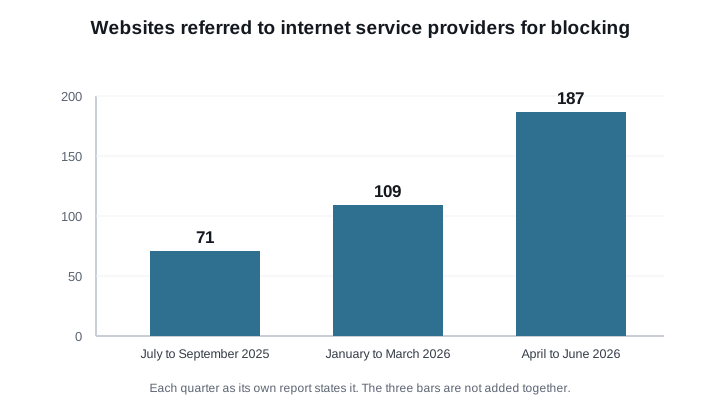
The figure above records what each quarter's own report states about websites the regulator referred to internet service providers for blocking. The three quarterly figures are 71 for July to September 2025, 109 for January to March 2026 and 187 for April to June 2026, and they are stated by the reports for those quarters rather than derived. Claims 46, 45 and 44. A reader should read the three bars as three quarterly statements, each from its own report, and should not add them together. No cumulative total is published anywhere that could be read, and the figure in circulation is a news report rather than a regulator's own number. Claim 48.
The reason to include the figure on a page about pokies is that it shows the enforcement machinery operating at the network level rather than at the level of any single provider. Blocking referrals are a different mechanism from the section 15 offences, and the quarterly counts are the published record of how that mechanism is being used. The figures rise across the three quarters, and a reader can see the direction without needing a cumulative total. What the figures do not show is anything about a particular brand, and they should not be read as a statement about any offer in the table above. Claims 44, 45, 46 and 48.
A reader who wants to use the figure should use it for what it is: a published record of quarterly referrals. It is not a count of operators, because no count of offshore operators serving Australia is published by any source reached. Claim 25. It is not a measure of the size of the market, and it is not a measure of the effect of blocking on any particular product. The value of the figure is that it shows the enforcement mechanism in operation, on the regulator's own numbers, across three quarters. The caution is the one the caption states: the three bars are not added together. Claims 25, 44, 45, 46 and 48.
Questions readers ask about Australian online pokies
- Is there a licensed Australian online casino I can play pokies at?
- No. There is no licensed Australian online casino. The Act contains no category for one, and the prohibition in section 5(1) applies to the ordinary case without any licensing exclusion to rescue it. Claim 5. The comparison a reader might expect between a brand licensed in Australia and a brand licensed offshore cannot be made, because the first side of that comparison does not exist for this product.
- What makes an online pokies product a gambling service under the Act?
- Section 4 paragraph (e) brings within the definition a game of chance or a game of mixed chance and skill played for money or something else of value where a customer gives consideration in connection with the game. Online pokies, roulette, blackjack and live dealer formats sit inside that paragraph. Claim 1.
- How does the section 5(1) prohibition work?
- Section 5(1) defines a prohibited interactive gambling service as a gambling service provided in the course of business to customers using an internet carriage service. A gambling service under paragraph (e), provided in the course of business, over an internet carriage service, is a prohibited interactive gambling service. Claim 2.
- Does any exclusion in section 5(3) rescue an online casino?
- No. An online casino served at home is a gambling service under paragraph (e), in the course of business, over an internet carriage service, and is therefore prohibited under section 5(1), excluded by nothing in section 5(3). There is no exclusion for a licensed online casino because the Act contains no such category. Claim 5.
- What is the dollar maximum penalty under section 15?
- No primary source states a dollar maximum penalty under section 15. The Act states the penalty in units, and the instrument states the value of a unit. Multiplying the two is arithmetic rather than a sourced figure. Nothing is published on the dollar maximum. Claim 22.
- What is the value of a penalty unit?
- The Crimes (Amount of a Penalty Unit) Instrument 2026 was made on 15 June 2026 under section 4AA(1A) of the Crimes Act 1914 and sets the penalty unit at $364 for offences committed on or after 1 July 2026. Claim 20. Previous values were $330 from 7 November 2024 and $313 from 1 July 2023 to 6 November 2024. Claim 21.
- Does an Australian playercommit an offence by playing at a brand outside the framework?
- No primary source states in terms that an Australian player commits no offence. The offences in the Act are written about providers, but the published material does not go further than that, and a page should not convert it into the statement that it is legal for a reader to play. Claim 23.
- Is an agreement with a brand outside the framework enforceable?
- No regulations under section 69A have been located, and neither assertion is published. No page may say that such an agreement is unenforceable, and no page may say that it is enforceable. Both are unpublished. Claim 24.
- How many offshore operators serve Australia?
- No count is published by any source reached. Claim 25. A reader should be sceptical of any figure that purports to supply the number, because the published material does not contain one.
- What does the reasonable diligence standard in section 15(4) mean for me?
- Section 15(4) sets out the factors relevant to whether a provider used reasonable diligence. Claim 12. It is a standard applied in the assessment of a provider's conduct against the Act, not a checklist a reader can apply to a brand from the outside, and a product outside the Australian framework sits outside that assessment.
- How do I work out what a wagering multiple asks of my stake?
- Multiply the bonus by the multiple. A $200 bonus at forty times the bonus asks for $8,000 of staking. The calculator above does the multiplication for any pair of numbers, so two offers can be compared on the same basis. The output is a staking requirement, not a time estimate, and the operator's own site remains the source for the terms the calculator does not model.
- Where do I check the terms the table does not show?
- On the operator's own site. Cells reading "Check on the operator's own site" are terms the operator did not publish where they could be read on the date in the column header, and the operator's published terms are the document that governs. The Page on Reading the offers goes into how to read those terms.
- Why does the figure on this page show three quarterly numbers rather than a total?
- Because no cumulative total is published anywhere that could be read, and the figure in circulation is a news report rather than a regulator's own number. Claim 48. The three bars are separate quarterly statements, stated by the report for each quarter, and they are not added together.
What the deposit and the withdrawal terms actually decide
The terms that decide whether a pokies offer is workable are rarely the ones the headline emphasises. Minimum deposit and payout window sit in the table above for a reason, and the reason is that they set the floor and the horizon of the relationship. A minimum deposit sets the smallest amount a reader can put in, which in turn sets the size of the bonus the offer actually produces. A payout window sets how long the reader waits after a withdrawal request before the money is available, which is the term a reader feels most keenly and checks least often. Both are operator terms, and where the operator has not published one where it can be read, the cell says so rather than guessing.
Wagering and payment rails are the other half of the picture. Wagering is the term the reader can quantify with the calculator above, and it is the term that most changes the effective value of an offer. Payment rails determine how the reader gets money in and out, and a rail that is not supported in the reader's circumstances can make an otherwise workable offer unusable. The table records rails as the operator publishes them, in the operator's own language, and does not infer a rail from a brand's general reputation. A reader who wants to use a particular rail should confirm it on the operator's own site before depositing.
None of these terms is regulated by the Act in the way a reader might assume. The Act's machinery is directed at the prohibition of prohibited interactive gambling services and at the conduct of providers in relation to that prohibition, and it does not supply consumer terms for a deposit or a withdrawal. A reader who wants to know what a minimum deposit or a payout window is must read the operator's published terms, and the Act's contribution is to explain why the operator sits outside the Australian framework rather than inside it. Claims 2, 5 and 12. The two layers stay separate, and the separation is the point.
The practical habit that follows is to read the deposit and withdrawal terms before reading the bonus, and to run the bonus and the multiple through the calculator only once the deposit floor is known. A brand with a low minimum deposit and a high multiple can produce a small bonus with a large requirement, and a brand with a high minimum deposit and a lower multiple can produce a larger bonus with a requirement of similar size. The calculator makes the comparison possible, and the operator's own site makes it accurate. The table above is the starting point, and the reader's own circumstances supply the rest.
Payment rails, timing and the terms a brand controls
Payment rails are the least standardised column in the table and the one most likely to change between a reader's first look and the moment of a withdrawal. A brand publishes the rails it supports, and it controls the processing time attached to each. What the Act does not do, and cannot do on this page's reading, is set a timing obligation that would apply to a brand outside the framework. Claims 2, 5 and 12. The reader who cares about how quickly a withdrawal lands should therefore read the operator's published payout window and payment rails together, rather than treating either one as a promise.
The distinction between the rail and the window is worth drawing out. The rail is the channel: a card network, a bank transfer, a wallet, a voucher. The window is the time the brand states it takes to process a request through that channel. A brand can support a rail and still take a stated number of business days to process, and the two facts belong in the same sentence when a reader is comparing offers. The table records both columns on the operator's own stated terms, and where a term was not published where it could be read on the date in the column header, the cell says so. That is the honest treatment, and it is more useful than a figure invented to fill the gap.
There is also a structural point about rails that a reader should keep in mind. A brand outside the Australian framework is not subject to the Act's provider-facing machinery, and the absence of that machinery is the comparator argument stated at the level of a single withdrawal. A reader who wants the details of how a brand handles a payment should look at the brand's published terms, because that is the document that governs the relationship, and should treat any claim about timing that is not in those terms as unconfirmed. Claims 2, 5 and 12. The page can describe the mechanism; it cannot supply the term.
Stake, session length and why the calculator stops where it does
The calculator above stops at the staking requirement, and the reason it stops there is that the next step depends on terms the operator publishes rather than on arithmetic. Game weighting, maximum bet rules and time limits all change how a staking requirement translates into a session, and none of them can be modelled from the two inputs the calculator takes. A reader who wants a time estimate should read the operator's published terms and apply them to the staking requirement the calculator produces, rather than using the requirement as a proxy for hours. The distinction keeps the calculator honest and keeps the reader's expectations calibrated.
The value of running the multiplication anyway is that it turns a pair of marketing numbers into a single figure a reader can compare across offers. A reader who knows the requirement in dollars can compare two offers on the same basis, and can decide whether the difference in requirement is worth the difference in bonus. That is a better comparison than reading the headline bonus alone, and it is the comparison the page is set up to support. The figures in the table are the operator's own stated terms, and the calculator takes the bonus and the multiple as the reader finds them.
Session length is a reader's own variable, and the page does not model it because it cannot. What the page can do is name the terms that interact with it. A maximum bet rule can cap the stake per spin and therefore lengthen the time to meet a requirement. A time limit can shorten the window in which the requirement must be met. Game weighting can change how much of each stake counts towards the requirement. All three are terms the operator publishes, and all three should be read before a deposit rather than after. Claims 2 and 12 are the structural background; the terms themselves are on the operator's own site.
The honest summary is that the calculator answers one question well and declines the others. A reader who uses it for the one question gets a figure that is comparable across offers. A reader who tries to use it for the others gets a number that looks like an answer and is not. The page's preference is for the smaller, accurate answer over the larger, invented one, and the same preference governs the treatment of the unpublished claims elsewhere on the page. Claims 22, 23, 24 and 25 are all cases where the accurate answer is that nothing is published.
Licensing note
There is no licensed Australian online casino. The Act contains no category for one, and the prohibition in section 5(1) applies to the ordinary case without any licensing exclusion to rescue it. Claim 5. A reader who sees a licensing claim on a pokies brand should read it as a claim about a foreign regulator, and should treat the details of that claim as something to check on the operator's own site. The absence of an Australian category is the reason this page does not offer a licensed-here versus licensed-there comparison for online pokies. Claims 1, 2 and 5.
Where to go next
- Online slots Australia the pokies and slot products a reader meets in the Australian market, with the same statutory frame applied.
- Live casino Australia how live dealer formats sit inside the paragraph (e) definition and what that means for a reader choosing an offer.
- High roller casino Australia larger stakes, larger requirements, and how to read the terms that matter at the top of the range.
- Mobile casino Australia the same products delivered to a phone, and the same prohibition applied to the delivery over an internet carriage service.
- Best Australian online casino a reader's guide to comparing offers without a domestic licence category to compare against.
- Free pokies demo and free-to-play formats, and how they differ from a staked product under the Act's definition.
- Reading the offers how to read wagering, minimum deposit and payout window on an operator's own terms.
- How this site is paid the commercial arrangement behind the sponsored block, set out in full.