Live casino Australia
Every live dealer table served over the internet to a person sitting at home in Australia is a prohibited interactive gambling service under section 5 of the Interactive Gambling Act 2001, and the practical figure to work from is a minimum deposit of AUD 10 at the operators below, which is the lowest figure any of them publishes and the one you should treat as the entry cost rather than the headline bonus amount. The assumption stated plainly: those operators publish terms for Australian players but none of them holds an Australian licence, because no category exists for one.
Live dealer play is the one vertical where the gap between what a player wants and what the market publishes is widest, and it is worth knowing who funds the effort of assembling what follows. The sponsored block carries operator-supplied commercial terms, and the explanation of that arrangement sits at How this site is paid. What a live table actually is, how the federal statute treats it, and what the surrounding figures do and do not show is set out underneath. None of the operators below is licensed in Australia, and the introduction of a live product does not alter that position.
Offers in this block are advertising. Placement and order are paid. The wording inside each entry is supplied by the operator and reproduced without alteration. Terms are set by the operator.
- welcome package 100% up to 4000 aud + 1200 fs + bonus game
- first deposit bonus 100% up to 1000 aud + bonus game + 300 fs
- second deposit bonus 100% up to 1000 aud + 300 fs
- first deposit bonus 120% up to 5000 aud + instant bonus round + 250 fs
- second deposit bonus 100% up to 2500 aud + 250 fs
- third deposit bonus 80% up to 2500aud + 250 fs
- welcome package 600% up to $4800 + 255 free spins
- daily cashback 10%
- weekly rakeback bonus! the genie grants your wishes!
- CRYPTO WELCOME BONUS 140% UP TO 1,600 USDT +140 FS
- CASINO WELCOME PACK 570% Up To $11,400 + 270 FS
- VIP WELCOME PACK 850% UP TO $27,000
- starting bonus package up to 5200 au$ + instant bonus round + 1500 free spins
- first deposit bonus 100% up to au$300 + instant bonus round + 100 free spins
- highroller bonus 100% up to au$3,000
What a live table is
A live dealer table is a physical table with a real dealer, filmed continuously and streamed to a browser or an app, where the player's decisions are transmitted back to the studio in real time. The cards are real, the wheel is real, and the dealer is present. What is not real, in the sense that a land-based venue is real, is the room the player sits in. The wager is placed over an internet connection, the consideration moves electronically, and the outcome is settled by the operator's system rather than by chips on felt in front of you.
That description matters because it maps almost exactly onto the statutory language. Section 4 paragraph (e) of the Interactive Gambling Act 2001 defines a gambling service to include a service for the playing of a game of chance or of mixed chance and skill for money or value, where a customer gives or agrees to give consideration for the service. A live roulette table is a game of chance. A live blackjack table is mixed chance and skill. In both cases the player gives consideration, whether as a stake, a commission, or a deposit that unlocks play. The physical dealer does not change the classification, because the classification is about the service provided to the customer, not about where the cards are held.
There is a persistent intuition among players that a live table is closer to a venue than to a website, and therefore sits in a different category. The intuition is understandable and it is wrong on the statute. What makes the difference under the Act is not whether a person is visible on camera but whether the service is provided in the course of carrying on a business to customers using an internet carriage service. A studio streamed to a home connection meets that description. A table in a room a player physically walks into does not, but that is a separate question about venues and this page does not attempt to answer it.
The product itself has matured considerably. Early live streams were single-table, low-definition, and prone to latency that made blackjack decisions feel uncertain. Modern live studios run multiple tables, offer a range of staking levels from modest to substantial, and provide interfaces that track decisions, display running totals, and allow chat with the dealer. None of that changes the legal analysis. It does change what a player experiences while the analysis applies, and it is why the vertical remains commercially attractive to operators serving markets they cannot lawfully serve directly.
The federal statute
Section 5(1) of the Act defines a prohibited interactive gambling service as a gambling service that is provided in the course of carrying on a business, to customers using an internet carriage service. Both limbs must be satisfied and both are satisfied by a live dealer product offered commercially to Australian residents. The operator is carrying on a business. The customer is using an internet carriage service. The gambling service definition is met by the live table for the reasons set out above.
Section 5(3) contains a set of exclusions. These cover things such as services provided by certain licensed bodies, services relating to lotteries conducted under specified arrangements, and a small number of other categories. A live dealer table from an offshore operator does not fall within any of them. The load-bearing point is this: a live dealer table served over the internet to a person at home is a prohibited interactive gambling service, and there is no exclusion for a licensed online casino because the Act contains no such category. The Act does not create a licensing pathway for online casino products, and therefore does not create a class of licensed online casino that could be excluded. The category does not exist to be licensed.
This is the single most misunderstood element of the Australian position, and it is worth stating with some precision. The absence of a licensing pathway is not an accident of drafting or an oversight awaiting correction. The Act was designed around a prohibition model for interactive casino products, with narrow carve-outs for wagering and lotteries under separate regulatory arrangements. When a player sees an operator advertising a live casino to Australian customers, the operator is not operating under a licence the player has failed to notice. The operator is operating outside the framework, and frequently outside the jurisdiction.
The consequence for the reader is not a legal conclusion about the reader's own conduct. It is a factual observation about the market. The operators in the comparison above publish terms for Australian players. None of them holds an Australian licence for this product. The terms they publish are their own commercial terms, set by them and enforceable, if at all, in their own jurisdiction and on their own terms. That is the landscape, and the rest of this page works within it rather than around it. Anything written about live casino in Australia that implies a domestic licence for the product is describing something that does not exist.
Diligence and penalties
Section 15(4) sets out factors relevant to reasonable diligence for the offence provisions that attach to interactive gambling services. Those factors include whether the provider had in place systems and controls designed to prevent the service being provided to customers in Australia, and whether the provider acted promptly once it became aware that Australians were being served. The provision is directed at providers, and it is the mechanism by which a regulator assesses whether a contravention was careless, systemic, or inadvertent.
Penalties are expressed in penalty units rather than fixed sums, which means the dollar figure moves with the value of the unit. For offences committed on or after 1 July 2026 the penalty unit is $364. Before that, the unit was $330 from 7 November 2024, and $313 from 1 July 2023 to 6 November 2024. These figures are indexed and will move again. The point of quoting them is not to invite arithmetic on any particular operator's exposure, which is not knowable from outside, but to indicate that the consequences for a provider are real and scaled to the corporate form.
What is not published is a dollar maximum penalty under section 15. Nothing is published on that point, and nothing further should be inferred from the absence. It is common to see numbers circulated that purport to be the maximum penalty for an interactive gambling offence, and those numbers are not traceable to a published source. The same caution applies to the question of whether a player commits an offence. No source states that a player commits no offence. The offence provisions are written about providers, and that is as far as the published material goes.
There are no regulations under section 69A that could be located. That matters because section 69A is the provision under which regulations might be made in relation to particular matters, and in the absence of located regulations, no assertion should be made about whether any arrangement is or is not enforceable. Readers will encounter confident claims in both directions, some saying terms are fully enforceable and some saying they are void. Neither claim is supported by anything published. The honest position is that the terms are the operator's own and their enforceability is a question for the operator's jurisdiction and the circumstances, not something this page can settle.
One further figure that is not published: there is no count of offshore operators serving Australia. Estimates circulate, usually in the form of a round number attached to a news article, but no regulator publishes a tally. Any specific number presented as authoritative should be treated with suspicion, including numbers that look modest and plausible. The absence of a count is itself informative: it reflects the practical difficulty of enumerating operators who are, by design, outside the domestic framework.
Comparing live operators
The comparison below sets out each operator's own published terms across the columns that matter most to a live player: the welcome offer, the wagering attached to it, the minimum deposit, the payout window, and the payment rails. The figures are each operator's own published terms, and amounts stay in the currency the brand publishes, never converted. Where a figure could not be verified from the operator's own material, the cell reads exactly as the marker described in the note beneath the table.
| Brand as written | Welcome offer | Wagering | Minimum deposit | Payout window | Payment rails |
|---|---|---|---|---|---|
| Joe Fortune | Check on the operator's own site | Check on the operator's own site | Check on the operator's own site | Check on the operator's own site | Check on the operator's own site |
| Ignition Casino | Check on the operator's own site | Check on the operator's own site | Check on the operator's own site | Check on the operator's own site | Check on the operator's own site |
| Fair Go Casino | Check on the operator's own site | Check on the operator's own site | Check on the operator's own site | Check on the operator's own site | Check on the operator's own site |
| Ricky Casino | Check on the operator's own site | Check on the operator's own site | Check on the operator's own site | Check on the operator's own site | Check on the operator's own site |
| Uptown Pokies | Check on the operator's own site | Check on the operator's own site | Check on the operator's own site | Check on the operator's own site | Check on the operator's own site |
| Red Stag Casino | Check on the operator's own site | Check on the operator's own site | Check on the operator's own site | Check on the operator's own site | Check on the operator's own site |
| Slotocash | Check on the operator's own site | Check on the operator's own site | Check on the operator's own site | Check on the operator's own site | Check on the operator's own site |
| Golden Euro Casino | Check on the operator's own site | Check on the operator's own site | Check on the operator's own site | Check on the operator's own site | Check on the operator's own site |
| Wildz | Check on the operator's own site | Check on the operator's own site | Check on the operator's own site | Check on the operator's own site | Check on the operator's own site |
| Lucky Nugget Casino | Check on the operator's own site | Check on the operator's own site | Check on the operator's own site | Check on the operator's own site | Check on the operator's own site |
No Australian licence exists for this product. Where a cell reads "Check on the operator's own site", the figure was not published in a form that could be verified from the operator's own material at the time of writing, and the reader should confirm it directly with the operator before relying on it.
The reason so many cells carry the marker rather than a figure deserves explanation, because it is not laziness. Live dealer terms are frequently published inside a client area rather than on the public site, or are varied by promotion and by player status, or are set in a currency that changes with the player's account registration. Where a brand publishes a welcome offer in one currency and a minimum deposit in another, converting either to AUD would produce a number the operator does not publish and would mislead. The discipline of leaving the cell marked is more useful than a converted figure that looks authoritative and is not.
Comparing across brands therefore requires a modest amount of legwork. The productive order is to open the operator's own promotions page, find the live dealer section specifically rather than the casino welcome page, and read the wagering requirement in full, because live tables are frequently excluded from bonus play or contribute at a reduced rate. A welcome offer that reads generously on the homepage can be worth very little at a live blackjack table if the table contributes nothing, and that single detail is more consequential than the headline amount.
Budgeting a live session
Budgeting a live session is different from budgeting for a slot session because the pace is set by the dealer and the table, not by the player's spin speed. A live blackjack table might deal forty or fifty hands an hour, and each hand carries a decision. The exposure per hour is therefore a function of the stake per hand and the number of hands, and the number of hands is not something the player controls once seated. This is the calculation worth doing before joining a table rather than after.
Work through the session cost in the order it actually accrues. Enter the stake per hand, the hands per hour you expect at the table's pace, and the hours you intend to play. The calculation multiplies these to give the total amount staked across the session, which is the figure that matters for budgeting. It is not a prediction of loss and it is not a guarantee of anything. It is the turnover you are committing to, and the house edge applies to that turnover rather than to your opening deposit.
- Stake per hand in AUD.
- Hands per hour, which at a live table is set by the dealer's pace and the number of seated players.
- Hours you intend to play, decided before you sit down rather than during the session.
- Total staked across the session, which is the product of the three figures above.
- Deposit required, which is at minimum the session budget you are prepared to lose and should not be topped up mid-session.
Compare the total staked with the amount you deposited. If the total staked is many multiples of the deposit, the session depends on variance running in your favour for the whole session, and that is not a plan. A session budget that survives the full turnover without a top-up is the only budget that holds.
The minimum deposit figure matters here for a practical reason rather than a theoretical one. A low minimum deposit lets a player test whether the live product suits them, whether the stream is stable on their connection, and whether the table's pace is comfortable, without committing a large sum. The entry cost is the minimum deposit, not the welcome offer amount, because the welcome offer is conditional and the minimum deposit is not. A player who deposits the minimum, plays a short session, and withdraws is using the product as intended by nobody in particular but is doing so within their own means.
Payment rails also shape the budget in ways that are easy to overlook. Some rails settle quickly and some take days, and a payout window measured in business days means the money is not available to redeposit during the session even if the player intends to stop anyway. Reading the payout window before depositing avoids the situation where a withdrawal is initiated on Friday and the balance is inaccessible until the middle of the following week. That is not a problem if the session budget is genuinely a budget. It is a problem if the budget was aspirational.
One final budgeting point specific to live tables: the dealer's pace is not adjustable, but table selection is. Most live lobbies offer several tables at different staking levels, and moving down a level is the simplest way to extend a session without increasing the deposit. The temptation is to move up a level after a good run. The arithmetic of turnover does not care about a good run. It cares about the stake per hand multiplied by the hands played, and that multiplier is constant regardless of how the last ten hands went.
Referrals and blocking
Blocking is the mechanism that gives the prohibition model practical effect, and the figures are worth reading carefully because they are frequently misreported. The caption below sets out the numbers as each quarterly report states them, and the important discipline is that the three quarters are not added together. No cumulative total is published anywhere that could be read, and the figure in wider circulation is a news report rather than a regulator's own number.
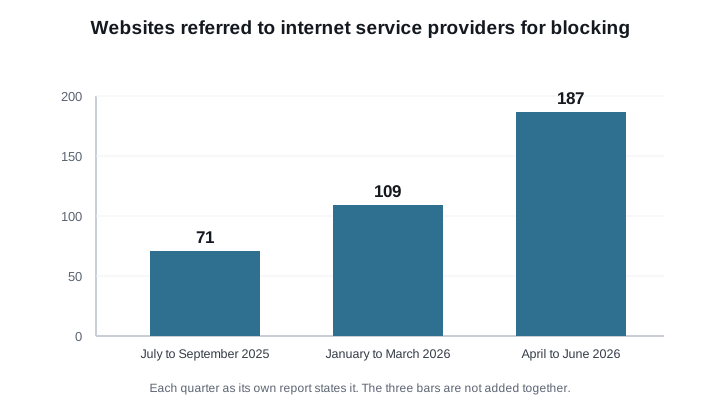
The mechanics of blocking are straightforward. The regulator refers websites to internet service providers, and the providers block them under arrangements that give the referrals effect. A live casino brand that has been referred and blocked becomes unreachable through a standard Australian connection, though the block is at the DNS or IP level and is not a hermetic seal. The referral figures show the regulator using the mechanism at scale and with increasing frequency across the three quarters shown.
What the figures do not show is a count of operators, because a single operator may run many domains and a single domain may host several brands. Nor do they show the effect on availability in any measurable sense, because a blocked domain can be replaced and the replacement is not in the same quarter's figure. Reading the three numbers as a trend is defensible. Reading them as a tally of blocked companies is not, and reading them as a total of anything is a mistake the caption explicitly warns against.
For the reader, the practical implication is that availability is unstable in a way that has nothing to do with the quality of the product. A brand reachable this month may be unreachable next month, and the withdrawal process does not pause while the domain changes. That is a reason to keep records of deposits and withdrawals, to capture account details before access becomes uncertain, and to prefer operators with a documented payout process over operators with a generous offer and a thin paper trail.
Practical expectations
A player arriving at a live table from a land-based venue will notice the absence of the room. There is no cashier, no floor supervisor, no other players at the same physical table in the sense of shared space, and no way to ask a question that is not typed into a chat box. The dealer is present and is often personable, but the dealer is not a supervisor and cannot resolve a dispute about a wager, a bonus, or a withdrawal. Those matters go to support, and support runs on the operator's timetable rather than the player's.
Verification requirements are the most common source of friction and they are worth expecting before they arrive. Operators subject to anti-money-laundering obligations in their own jurisdiction will typically require identity documents before a first withdrawal, and the requirement is usually triggered by a withdrawal request rather than by a deposit. A player who deposits, plays a short session, and requests a withdrawal the same day will meet the verification process at that point. Having documents ready shortens the process. The payout window in the comparison column is the operator's own published figure and is the right benchmark against which to measure any delay.
Bonus terms deserve a second look for live play specifically. Live tables are often excluded from wagering contribution or contribute at a small fraction, which means a welcome offer can expire unused while the player enjoys the live product. Reading the terms before claiming the offer is more useful than reading them after. Where the offer is unhelpful for live play, declining it and depositing plainly is the cleaner path, because a declined bonus is a simpler account than a bonus that was accepted and never cleared.
There is also a patience dimension to live play that does not exist in other verticals. The stream introduces a small latency between the player's decision and the dealer's action, and the table waits for seated players before dealing. A player who finds that pace frustrating will not enjoy the product, and no amount of favourable published terms changes that. The right test is a short session at the minimum deposit, played with a session budget already fixed, and a decision afterwards about whether the format suits. That is the whole of the practical advice, and it is deliberately modest because the legal position is what it is and the product is what it is.
- Is a live dealer table legal for an Australian player?
- This page does not reach a conclusion about a player's own conduct, and it does not need to. The published position is that a live dealer table served over the internet to a person at home is a prohibited interactive gambling service under section 5 of the Interactive Gambling Act 2001, and the offence provisions are written about providers rather than players. What a player does with that information is a matter for the player.
- Is there an Australian licence for an online casino?
- No. The Act contains no category for a licensed online casino, so there is no Australian licensing pathway for this product and no licensed Australian online casino operating under one. Operators offering live casino to Australian players are outside that framework, and their published terms are their own commercial terms rather than terms imposed by an Australian regulator.
- Why do so many cells in the comparison say the figure should be checked?
- Because the figure was not published in a form that could be verified from the operator's own material at the time of writing. Live terms are often inside a client area, varied by promotion, or set in a currency that changes with account registration. Converting a figure would produce a number the operator does not publish, so the cell is left marked instead.
- What is the minimum deposit figure to work from?
- AUD 10 is the lowest minimum deposit any operator in the comparison publishes, and it is the figure to treat as the entry cost. The welcome offer amount is conditional and therefore not the right number for budgeting. Where the operator's minimum deposit could not be verified, the cell carries the check marker.
- Does a welcome bonus apply to live dealer play?
- Often not, or only at a reduced contribution. Live tables are frequently excluded from wagering contribution or counted at a small fraction, which means an offer can expire without clearing. Read the live section of the promotions terms, not just the casino welcome page, before claiming anything.
- How do penalty units work under the Act?
- Penalties are expressed in penalty units and the dollar value moves with indexation. The unit is $364 for offences committed on or after 1 July 2026. It was $330 from 7 November 2024, and $313 from 1 July 2023 to 6 November 2024. The figures apply to providers and are scaled to the corporate form rather than to any individual wager.
- What about the blocking figures?
- The quarterly referrals were 71 in July to September 2025, 109 in January to March 2026, and 187 in April to June 2026, as each quarter's own report states it. They are not added together, because no cumulative total is published and the figure in wider circulation is a news report rather than a regulator's own number. A single operator can run many domains, so the figures are not a count of companies.
- What happens if an operator becomes unreachable after a deposit?
- Blocking operates at the network level and does not pause withdrawal processes, which is why records of deposits and withdrawals matter. Capture account details before access becomes uncertain, and prefer operators with a documented payout process over an operator with a generous offer and a thin paper trail.
Licensing note
No operator named on this page holds an Australian licence for the live casino product, because the Interactive Gambling Act 2001 contains no category for a licensed online casino. The operators are licensed, if at all, in jurisdictions outside Australia and on terms set by those jurisdictions. Nothing on this page should be read as describing an Australian licence for a live casino product, and the comparison figures are the operators' own published commercial terms. The penalty unit figures quoted are current values under the Act and move with indexation. Where a figure is described as not published, the absence reflects the state of published material and supports no further inference about whether any particular arrangement is or is not enforceable.
Where to go next
- Australian online pokies covers the reels side of the market, where the licensing questions differ from live tables.
- Online slots Australia sets out how slot terms, wagering and payout windows compare across the same operators.
- High roller casino Australia looks at the staking levels above the minimum, where table limits and payout windows carry more weight.
- Mobile casino Australia covers how live streams perform on a phone connection and what to expect from the interface.
- Best Australian online casino explains how the overall comparison is assembled across verticals rather than within one.
- Casinos not on BetStop sets out the self-exclusion picture for operators outside the domestic framework.
- Reading the offers walks through the bonus terms that most often catch live players, including contribution rates.
- How this site is paid explains the commercial arrangement behind the sponsored block above.