Instant withdrawal casino Australia
The word instant appears in front of a great many Australian-facing casino offers, and the information below assumes the phrase is a marketing label rather than a measurable claim. Of the 13 offer summaries described on this page, the number that comes with a published, verifiable payout timeframe from an independent source is zero.
This page is advertising. The order in which offers appear is bought, and the wording used to describe them is supplied by the operators themselves rather than written or edited here. No figure on this page has been checked against a primary source, no timeframe has been timed, and no operator is named. How the commercial arrangements work is set out on How this site is paid.
Offers in this block are advertising. Placement and order are paid. The wording inside each entry is supplied by the operator and reproduced without alteration. Terms are set by the operator.
- welcome package 100% up to 4000 aud + 1200 fs + bonus game
- first deposit bonus 100% up to 1000 aud + bonus game + 300 fs
- second deposit bonus 100% up to 1000 aud + 300 fs
- first deposit bonus 120% up to 5000 aud + instant bonus round + 250 fs
- second deposit bonus 100% up to 2500 aud + 250 fs
- third deposit bonus 80% up to 2500aud + 250 fs
- welcome package 600% up to $4800 + 255 free spins
- daily cashback 10%
- weekly rakeback bonus! the genie grants your wishes!
- CRYPTO WELCOME BONUS 140% UP TO 1,600 USDT +140 FS
- CASINO WELCOME PACK 570% Up To $11,400 + 270 FS
- VIP WELCOME PACK 850% UP TO $27,000
- starting bonus package up to 5200 au$ + instant bonus round + 1500 free spins
- first deposit bonus 100% up to au$300 + instant bonus round + 100 free spins
- highroller bonus 100% up to au$3,000
What "instant" actually means
In the offshore casino segment that advertises to Australian readers, the word instant almost never refers to the moment money lands in a bank account. It refers to the moment the operator's own systems finish with the request. Those are two different events, often separated by hours or by days, and the gap between them is where most of the disappointment in this category is created.
When an offer says instant withdrawal, what is usually being described is one of three things. It may mean that the operator's front-end processes the request without a manual queue, so the status changes from pending to approved quickly. It may mean that the operator has no internal waiting period written into its published terms, so it does not hold a request for a set number of hours before looking at it. Or it may mean nothing more than that a payment method is accepted at all, with the word instant attached to the method rather than to the money. None of these three meanings tells a reader when the funds will be available to spend.
The distinction matters because the reader's experience is governed by the last step, not the first. An operator can legitimately describe its side of the transaction as instant while the receiving bank, the card network or the payment intermediary takes its own time. The claim is not necessarily false. It is simply a claim about a different event from the one the reader cares about. This page does not resolve that ambiguity for any operator, because resolving it would require timed, independently verified data that does not exist in public form for this segment.
There is also a terminology problem. Words like fast, instant, same-day and priority are not defined terms in this market. No shared standard fixes what instant means, no industry body publishes a threshold, and no regulator in the offshore segment publishes a distribution of payout times. A reader comparing two offers that both use the word instant has no basis for assuming the two operators mean the same thing. The label is a positioning choice, not a specification.
The three delays behind every withdrawal
Every withdrawal request passes through at least three stages, and only the first belongs to the operator. Understanding the sequence is the most useful thing a reader can take from this page, because it explains why a single headline figure would be misleading even if one existed.
The first delay is internal review on the operator's side. This covers identity checks, checks against the operator's own account records, any review of how the funds were built up, and the administrative step of approving the request. Some operators do this quickly and some do not, and the published terms of an operator are the only place where any of it is described, often vaguely. This is the stage the word instant is usually describing, and it is the only stage an operator fully controls.
The second delay belongs to the payment rail. Different methods move money through different infrastructure, and each has its own operating rhythm. A card network, a bank transfer system and a digital asset network are not comparable, and none of them is controlled by the casino. An operator can submit a payment promptly and still have the rail take its own time to settle it. Nothing an operator writes in a promotional sentence changes how a rail behaves.
The third delay belongs to the receiving institution. Once funds reach a bank or a payment provider on the reader's side, that institution applies its own processing, its own cut-off times and its own holds. Weekend and public holiday timing can push a payment that was approved on a Friday into the following week. None of this is visible to the casino, and none of it appears in an offer summary.
Because the three delays compound, a request approved in minutes can still take days to become spendable money, and a request approved slowly can occasionally clear faster if the rail happens to be quick. This is why any single number attached to an operator is close to meaningless without knowing which stage it describes. The honest position is that the reader cannot know the total from a marketing sentence, and this page will not invent one.
Why no published market numbers exist
There is no published figure for withdrawal times in the Australian offshore casino segment. Not a median, not an average, not a range, not a distribution. This is not a gap this page is filling with estimates. It is a structural absence, and it has identifiable causes.
The first cause is that no one is measuring. Timing data lives inside operators and inside payment processors, and neither has any reason to publish it in a form that allows comparison. A regulator that does not license a segment has no dataset for it, and the offshore segment by definition sits outside the licensing arrangements that would generate one. What exists instead is anecdote: forum posts, review-site summaries and affiliate copy, all of which are unverifiable and all of which are shaped by commercial incentives.
The second cause is that the number would not be stable even if it were measured once. Withdrawal speed depends on the method, the amount, the account's history, the time of day, the day of the week, the currency and the receiving institution. A single figure for an operator would average across conditions that behave very differently. A figure that claimed to describe the market would average across operators as well, compounding the problem.
The third cause is that the parties who could publish have nothing to gain from doing so. An operator with slow payouts would not publish, and an operator with fast payouts would publish selectively, in conditions of its own choosing, in a way that flatters it. Neither produces the kind of dataset a reader could rely on.
The practical consequence is that any page presenting a clean table of payout times for offshore casinos is presenting something it cannot have verified. This page does not do that. It says instead that the number does not exist in public form, and that a reader should treat any specific timeframe attached to an offshore offer as unverified marketing until an independent source confirms it.
What operators publish and what they leave out
What an operator publishes tends to be a short list of approved methods, a statement that withdrawals are processed within some period, and a note that banking times are outside its control. The generic disclaimer is usually there, tucked into terms rather than into the promotional sentence. That disclaimer is the honest part of the document, and it undercuts the headline.
What is usually absent is any breakdown by method, any statement of how long the internal review actually takes in practice, any data on how often requests are held for additional checks, and any information about what triggers those checks. The absence is not accidental. Publishing a breakdown would create a benchmark the operator could be held to, and publishing hold rates would invite questions about why requests are held.
What is also absent is any statement of the conditions under which the advertised speed does not apply. First withdrawals, unusually large withdrawals, withdrawals following a deposit method change and withdrawals to a newly added destination are common triggers for additional review, and an offer that says instant rarely says so subject to conditions in a way a reader would notice. The reader discovers the conditions at the moment they matter.
This page takes the position that a published term is a statement of intent rather than a guarantee of outcome, and that the promotional sentence at the top of an offer should be read last rather than first. The terms are where the useful information sits, and even the terms describe the operator's side of the transaction only.
Reading instant in the language of this offer class
When an offer in this class uses the word instant, the most useful reading is that the operator wishes to be compared with other operators using the same word. It is a positioning claim in a crowded field, not a description of a measured process. The reader who understands this can still use the offer summaries on this page for what they are: commercial placements, ordered by arrangement, described in the operator's own words.
Several habits make the summaries easier to read without being misled. Treat any timeframe as unverified until a source outside the operator confirms it. Treat the method list as a statement about what is accepted rather than about how quickly it arrives. Treat the generic banking disclaimer as the most reliable sentence on the page. And treat the absence of a breakdown by method as informative in itself, because an operator with genuinely consistent processing would have little reason to hide the detail.
This site's own assumptions about what a reader can and cannot verify are set out on The margin we assume, and the general approach to reading promotional language is on Reading the offers. Neither page supplies a payout figure, because none can be supplied honestly.
Readers who want to compare how money moves rather than how fast a claim says it moves can look at the method-specific pages: PayID casino, E wallet pokies, Crypto casinos and Bitcoin casino Australia. Each describes a rail, not a promise about a rail. Cashback arrangements, which work differently again, are described on Cashback casino Australia.
Wagering rules and why they are a different product
This section compares published rules for wagering products, using the claim numbers assigned in this site's source register. Wagering is a different product from casino play. The rules below describe obligations that attach to licensed wagering providers in Australia, and they do not reach offshore casino operators, because those operators are not within the framework the rules are written for.
The National Self-Exclusion Register, known as BetStop, is established under s 61HA(1) and began operating on 21 August 2023 (54, 56). It is a free and secure way for a person to exclude themselves from all online and phone wagering providers licensed in Australia in one go (61). There is no partial exclusion: registration covers all of them rather than a chosen subset (62). The minimum exclusion period is three months, and a registration can run up to a lifetime (63). Registering takes about five minutes and requires a mobile number, an email address and one of an Australian driver licence, an Australian passport or a Medicare card (64).
While a person is registered, a provider should not open an account, should not allow bets, should not send marketing, and should close accounts and refund credit (65). The marketing prohibitions sit in ss 61LA to 61LD (66). Accounts are not reactivated afterwards (67), and pending bets are the one carve-out (68). Providers check registration status under s 61NC(1) (69), though the checking obligation has no fixed timing attached to it (70), and a due diligence defence is available under s 61KA(5) (71). Providers are also required to promote BetStop under s 61JP (72). There is an early cancellation procedure, which is described here so a reader can see what the commitment costs to unwind rather than as a route out of anything (73). Separate schemes exist for venues (75), and up to five support people may be nominated in connection with a registration (77). As at 30 June 2025, nearly 45,000 Australians had excluded themselves, with more than 30,000 active exclusions (78).
Two things are not published and should not be implied. First, no primary source quantifies how many offshore casinos accept registered individuals: what exists is a statement about a duty, not about behaviour (81). Second, nothing here describes, and no page should describe, how a registered individual could gamble (82). A page that presents registration as ineffective for a particular product is making a claim about behaviour that the published record does not support, and a reader should treat any such claim with suspicion.
A parallel body of rules governs inducements, which are a matter of State and Territory law (99), with Queensland's consumer information page being one published example (100). The framework applies to all licensed online wagering service providers (102), and that is the limit of its reach. Anti-money-laundering obligations apply to reporting entities under the AUSTRAC regime, with the relevant rules taking effect from 29 September 2024 (143); the NCPF measure 3 addresses a related area (145). Two items in this register are marked not published (146, 147), and this page does not fill the gap with speculation.
The central limitation for a reader of this page is simple. The obligations described above are obligations on wagering providers. A casino game is not a wagering service in the sense these rules use, and an offshore operator is outside the licence that makes the obligations apply at all. BetStop's own wording is explicit that the register does not apply to online casino games or other gambling services that are illegally provided in Australia, and that a complaint about such services can be made to the ACMA (60). That is a statement that the register's obligations stop at a boundary. It is not a statement that anything on the other side of the boundary is safe, legal or unregulated in practice. Readers interested in the boundary itself can read more on Casinos not on BetStop, which should be read as a description of scope rather than an endorsement.
The practical point for withdrawal questions is that none of the wagering rules above says anything about how fast money moves. A reader who registers with BetStop is not thereby given any information about payout times at an offshore casino, and a reader who is not registered is in the same position. The two subjects are unrelated, and this page keeps them separate.
[agbo-table]What waiting costs
Your own arithmetic. This is not a payout window. No payout window is published for the offshore market.
Where self-exclusion stops, and what that does not mean
Self-exclusion through BetStop is a serious commitment with real obligations on the providers it covers. The register applies to Australian-licensed online and phone betting operators (59). It does not apply to casino games, and its own published wording says so (60). That is the extent of the claim this page makes: the registration, on its own terms, does not reach an offshore casino. It is a statement about the reach of an obligation, not a statement that any particular operator will accept any particular person (81).
This distinction is easy to lose and important to keep. Saying that the register does not reach a segment is not the same as saying that the segment is unregulated, that checks do not happen, or that a person could use that gap for anything. Those are claims about behaviour, and the published record does not support them (81). This page does not describe how any check works or does not work, does not describe how a registration could be worked around, and does not describe how a payment or an account could be arranged to avoid anything. A reader looking for that will not find it here, and a page that offers it should be treated as unreliable about everything else too.
What a reader can reasonably take from the scope rules is narrower. If a person's concern is their own behaviour around casino play, the register is not the instrument that addresses it for offshore products, and other steps matter more. The page on Knowing when to stop is a better starting point for that question than any page about withdrawal times. Support people can be nominated in connection with a registration (77), and the early cancellation procedure exists so that a reader can see the full cost of the commitment before making it (73), not as a way out afterwards.
Identity verification is a separate subject and one that interacts with withdrawal. A first withdrawal is frequently where an operator's identity checks become visible, because that is the point at which the operator has a reason to confirm who it is paying. This page does not describe what any operator's checks involve, does not recommend a sequence of steps and does not say how to avoid them. It notes only that verification and payout timing are connected, and that the connection is one more reason a single headline figure cannot describe a real experience. Readers who want the general shape of that subject can read Online casino no verification withdrawal Australia.
Complaints are the last boundary and they follow the same pattern. The complaints route works only for licensed operators (161). For services outside that scope, BetStop's own wording points to the ACMA (60). Separately, the Australian Consumer Law is stated to apply to gambling businesses (162), which is a statement about the framework's stated reach rather than a prediction about any particular outcome. This page does not assert that any remedy is available or enforceable against any operator, and a reader should not read the sentence above as an assurance that it is.
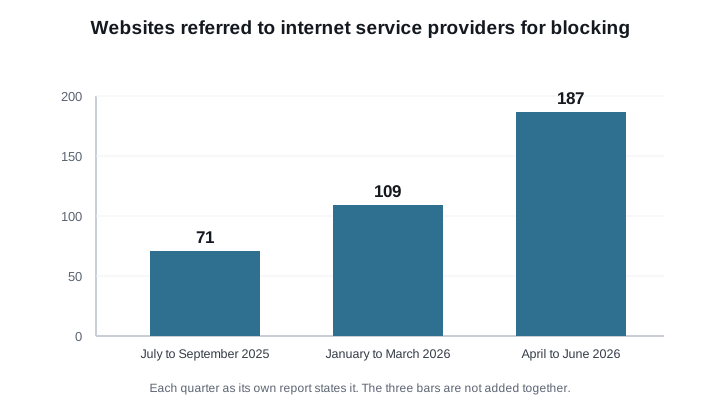
The blocking figures above are about referral activity by the regulator, not about payout speeds or about the behaviour of any operator. They are included because they show how the published record is built: quarter by quarter, in the regulator's own words, with no cumulative number that can be read off. The same discipline applies to every other number a reader is likely to encounter in this segment, including the ones that look most precise.
Frequently asked questions
- Does "instant withdrawal" mean the money arrives instantly?
- No. In this segment the phrase almost always describes the operator's own processing step rather than the arrival of funds. The payment rail and the receiving institution add their own delays, and neither is controlled by the casino. This page does not supply a timeframe for either.
- Is there a published average withdrawal time for Australian-facing offshore casinos?
- No. There is no published median, average or range for this segment from any source that could be checked. The data lives inside operators and processors, is not comparable across methods and conditions, and no one publishes it. Any specific figure presented as market data should be treated as unverified.
- Why does the operator say one thing and the bank take longer?
- Because the operator's statement describes its own approval step. Once a request leaves the operator it enters a payment rail, and after that a receiving institution, each with its own rhythm and cut-off times. A claim about the first step says nothing about the other two, and this page does not resolve the difference for any operator.
- Does registering with BetStop cover casino games?
- The register's obligations apply to Australian-licensed online and phone betting operators and, in its own published words, do not apply to online casino games or to other gambling services illegally provided in Australia. That is a statement about the reach of an obligation. It is not a statement about what any operator does, and this page does not make one.
- Can the word instant be trusted at all?
- It can be trusted as a statement of intent about processing, not as a specification. The word is not defined in this market, no shared threshold exists and no regulator publishes a distribution of payout times. Two offers using the same word are under no obligation to mean the same thing.
- Does the order of the offers on this page mean anything?
- Yes, it means that the position was bought. The wording of each summary is supplied by the operator and has not been checked against a primary source. The arrangement is described on the page about how this site is paid.
- Why is identity verification connected to withdrawal?
- A first withdrawal is often where an operator's checks become visible, because that is when the operator has a reason to confirm who it is paying. This page does not describe any operator's checks, does not recommend steps around them, and treats the connection as one more reason a single headline figure cannot describe a real experience.
- Where can a complaint about an offshore casino go?
- The complaints route described in the licensing framework works only for licensed operators, and the register's own wording points complaints about services outside its scope to the ACMA. The Australian Consumer Law is stated to apply to gambling businesses, though this page does not assert that any particular remedy is available or enforceable.
Licensing note
This page is general information for Australian readers and is not legal, financial or regulatory advice. It describes the scope of published obligations and the structure of withdrawal delays. It does not assert that any operator is licensed, legal, enforceable against or safe, and it does not assert that any remedy exists for any reader. Where a rule is described, the description follows the claim numbers in this site's source register, and two items in that register are marked not published. No timeframe, payout figure or withdrawal duration for any operator, and none for the market as a whole, is stated on this page, because no such figure exists in a form that could be checked.
Where to go next
- Crypto casinos a payment rail with its own settlement rhythm and its own volatility, described without a payout promise.
- Bitcoin casino Australia how a digital asset rail differs from a card or bank transfer when a request leaves the operator.
- Cashback casino Australia a different kind of offer structure, and why the terms matter more than the headline.
- Casinos not on BetStop a description of the register's scope, not an endorsement of anything outside it.
- Online casino no verification withdrawal Australia the general shape of the verification question, with no steps around it.
- E wallet pokies an intermediary layer between operator and bank, and what that layer changes.
- PayID casino a domestic transfer method and the assumptions a reader should not make about its speed.
- Knowing when to stop the question that matters more than any withdrawal timeframe.