Pokies near me
If you search for pokies near me, the honest answer is that the phrase resolves to two different regulatory worlds, and the number that matters for this page is 87,749: the count of gaming machines in clubs and hotels in New South Wales alone at June 2024, as the state's Audit Office published it. That figure is a New South Wales figure and nothing else. It is not a national count, this page does not have a national count, and any figure presented as a national machine number should be treated as unverified here.
Why the phrase leads to two different worlds
When someone types pokies near me into a search field, they are usually trying to answer one of two questions, and the two questions have almost nothing in common. The first is a physical question: which venues close to me have gaming machines, what are they, and who watches over them. The second is a digital question: which websites offer pokies to people in Australia, and on what basis. A search engine will happily mix answers to both questions onto one screen, which is why the results can look contradictory. A page about a club a few suburbs away sits next to a page about an offshore site that has never held an Australian licence of any kind.
This page deals with both halves, but it keeps them in separate compartments and says plainly where the evidence stops. The venue half is better documented than most people expect, but only for one jurisdiction. The online half is far less documented than the marketing around it suggests, and the reason is structural rather than conspiratorial: there is no Australian licence for online casino play, so there is no licensing instrument and no technical standard against which an operator's advertised numbers could be checked. That absence is the central fact of the online half, and the rest of the online discussion on this page follows from it.
It is worth being precise about the term itself. In Australia, pokies means gaming machines in physical venues: the machines in clubs and hotels, and the machines in casinos. The word carries a set of expectations that were built up over decades of state regulation, including expectations about what a machine is allowed to do, how much it must return over time, and how the venue around it must behave. None of those expectations transfer automatically to a website. A website serving Australian players is not a venue, is not licensed by an Australian state, and is not subject to the machine standard that the states publish for machines in venues. When people carry the word pokies from the club down the road to a browser tab, they carry the expectations without the machinery that produced them.
This site analyses operator terms and the regulatory record. It does not run pokies, it does not take a position on whether any particular form of play is lawful for any particular person, and it does not reproduce operator claims as if a regulator had confirmed them. The sections below set out what the public record actually contains about nearby venues, what it contains about machine design, and where the record simply runs out. If you are looking for a list of venues with addresses and hours, this page does not have one, by design. If you are looking for a clear account of what is known and what is not, that is what follows.
The two worlds do share one thing: both are places where the gap between what a player assumes and what the documentation supports can be wide. On the venue side the documentation is real but jurisdiction-specific. On the online side the documentation is largely missing, and what fills the gap is marketing. Recognising which half of the search result you are reading is the first practical skill, because the questions you should ask of a club page and the questions you should ask of an operator page are not the same questions at all.
What state and territory law governs and what it does not
The Commonwealth Interactive Gambling Act sits above the state and territory systems, and its relationship to them is often misunderstood. Section 69 of the Act is explicit that the Act does not exclude or limit a state or territory law that is capable of operating concurrently with it. That single provision explains why the Commonwealth statute and the state licensing systems are not in competition. They run alongside each other. A state can license and regulate activity within its borders, and the Commonwealth Act continues to apply on its own terms.
A state or territory licence matters in exactly three places in the Commonwealth Act, and all three are worth naming because they define the boundary. Section 8B concerns excluded gaming. Section 8BA concerns place-based betting. Section 15AA concerns unlicensed regulated services. Each of these provisions is about place-based activity or about wagering, and the licence of a state or territory is the thing that determines how they apply. That is a narrow doorway, not a general permission. Nothing in this structure creates an Australian licence for online casino play, and nothing in it converts a state venue licence into authority to operate a website.
Section 15AA is the provision most often quoted in operator marketing, so it deserves a careful reading. Subsection (7) provides that the holder of a state or territory licence does not contravene subsection (1) or (3) of section 15AA by providing the kind of service covered by that licence in that state or territory, or beyond it. Subsection (8) states that this is said for the avoidance of doubt. The effect is to protect licensed state activity from being caught by the prohibited service provisions. It is a protection for the licensed activity described in the licence. It is not a general safe harbour, and it does not reach a service that no state has licensed.
The Queensland regulator's own page puts the practical position simply: providers are regulated by the state that licenses them. In Queensland the regulator is the Office of Liquor and Gaming Regulation. The same page notes that many online providers are licensed by the Northern Territory government. This is a useful corrective to the assumption that online gambling in Australia is entirely unlicensed. Some of it is licensed, by a state or territory, for the categories of activity that state or territory licenses. The correction is narrow, though. Being licensed by a state for a licensed category does not mean the operator holds a licence for online casino play, because no state issues that licence.
Here the record on this page stops, and it is important to say so rather than to fill the gap with inference. No source reached for this page states which state or territory licenses a land-based casino, or on what conditions. This page does not name a single casino licensing regime. That is not an oversight to be patched with general knowledge; it is the limit of what the sources say. If you see a claim that a particular casino is licensed in a particular way, treat it as a claim to be checked against the regulator's own register, not against a summary on a site like this one or on an operator's page.
The practical consequence for anyone searching pokies near me is that the legal position of the venue down the road is a state question with a state answer, and the legal position of the website in the next tab is a Commonwealth question with a much thinner answer. The state system regulates machines, venues, and the conduct of the people who run them. The Commonwealth system prohibits certain interactive services while leaving licensed state activity alone. Neither system produces a licence that would let this page confirm an online casino's machine behaviour, and that is why the online sections below are written as an account of missing rules rather than as a set of specifications.
What the Audit Office published about New South Wales
The most detailed public picture of the venue side comes from the Audit Office of New South Wales. Its report records 87,749 gaming machines in clubs and hotels in New South Wales at June 2024, across more than 2,000 clubs and hotels in 2023-24. Responsibility for the sector is shared between the Independent Liquor and Gaming Authority and the Department of Creative Industries, Tourism, Hospitality and Sport. The principal statute is the Gaming Machines Act 2001. These are the anchors for anything said about venues in that state, and they are the only anchors this page has for venue numbers anywhere.
The same report contains a figure that is often quoted without its qualifications. The Audit Office described venue profits as the best available indicator of the amount lost by people on gaming machines. On that basis the figure was $8.4 billion in 2023-24, more than $23 million a day. Within that, a high-risk group lost more than $1.4 billion on machines in clubs and hotels in the same year. These are New South Wales figures, they are profits rather than a direct measurement of individual losses, and the report itself frames them as an indicator rather than as a ledger. They are the best available measure for that state and they are not a national measure.
This is where discipline matters most. The Audit Office examined New South Wales and this page asserts nothing about other states or territories on the strength of that examination. The 87,749 machines are New South Wales machines. The $8.4 billion is New South Wales venue profit. The high-risk group loss of more than $1.4 billion is a New South Wales figure. If you add these to figures from elsewhere and present a national total, you are producing a number that no source on this page supports. This page does not name a national machine count and does not name a national loss figure, because the evidence for such figures was not reached. A search for pokies near me in another state should be answered with that state's regulator, not with a New South Wales number scaled up.
The report is also useful for what it shows about how the sector is watched. Two bodies share responsibility, which means that questions about machine numbers, venue conduct, and harm minimisation can land with different offices. The Gaming Machines Act 2001 is the governing statute, which means that the rules a venue follows are statutory rules, not voluntary codes. That distinction carries weight when comparing venues with websites. A venue's obligations can be pointed to in an Act and in a regulator's published material. A website's obligations, in the absence of an Australian licence, cannot be pointed to in the same way. The Audit Office can audit a venue system because a venue system exists to be audited.
Finally, the report's framing of profit as an indicator deserves a moment. It is a careful piece of wording. Venue profit is not the same thing as the total lost by players, because profit includes other revenue and because the relationship between machine takings and player losses involves the machine's own return settings. The Audit Office chose the word indicator deliberately, and this page keeps that word. Anyone who quotes the $8.4 billion as a direct measure of what players lost has moved one step beyond the source. The distinction matters for the same reason the whole page matters: the difference between a documented number and a number in circulation is exactly what a reader searching for pokies near me needs to be able to see.
Harm minimisation measures at venues
The New South Wales material also sets out a list of harm minimisation measures applied in venues, and the list is concrete enough to be useful as a contrast with the online world. The cash input limit for new machines was reduced from $5,000 to $500. There is a mandatory shutdown from 4am to 10am daily, with around a fifth of venues holding exceptions. There is mandatory training in responsible conduct of gambling. Venues with more than 20 machines must have a Responsible Gambling Officer. Venues maintain game management plans, incident registers, and self-exclusion programmes. There are rules about where ATMs may be placed and a prohibition on signage that directs people from the machine area to the cashier.
Two of these items are worth separating out because they are sometimes confused with design rules. The $500 cash input limit for new machines and the 4am to 10am shutdown are harm minimisation measures, not design parameters of the machine itself. They change what a venue must do and how a machine may be fed, not how the machine computes a result. The distinction sounds technical but it is the difference between a rule about the room and a rule about the device. When people ask what protects a player at a venue, the answer is a combination of both, and the Audit Office material is clear about which measure belongs to which category.
The daily shutdown is the measure most visible to anyone who has walked past a club in the early morning. Its existence tells you something about the regulatory posture: the state has decided that a period of unavailability is a legitimate tool, and it has accepted that a minority of venues will hold exceptions. The cash input limit tells you something similar about the state's willingness to constrain the mechanics of play directly. Neither measure has any counterpart on the online side, because there is no Australian licensing instrument that could impose one. That is not a criticism of any operator; it is a description of the regulatory gap.
The Responsible Gambling Officer requirement, which applies to venues with more than 20 machines, is a staffing rule rather than a machine rule, and it points at something the online side cannot replicate: a person in the room with a duty to intervene. The game management plans and incident registers are paperwork obligations that create an auditable trail. Self-exclusion programmes at venues rely on the venue knowing who is present, which a website does not in the same way. Each of these measures depends on the physical facts of a venue, and each of them therefore illustrates why the venue world and the online world cannot be regulated by the same instrument.
As with the numbers, the measures are New South Wales measures. This page does not assert that the same list applies in any other state or territory, because the sources reached examined one jurisdiction. A reader in another state who wants to know what applies locally should go to that state's regulator. The general lesson, though, travels better than the specific list: where a licensing system exists, harm minimisation measures can be imposed, published, and audited. Where no licensing system exists for the activity in question, there is no instrument to carry the measures, and the player is left with whatever the operator chooses to publish and whatever general consumer law might apply. That is the structural point the venue material makes when set beside the online material.
The gaming machine standard and what it leaves out
The only published design standard reached for this page is the Australian/New Zealand Gaming Machine National Standard, Revision 12.1, May 2025, issued by state regulators for gaming machines in venues. Its scope is important: it governs machines in venues and it regulates nothing online. That single sentence disposes of a great deal of confusion. A number taken from the national standard is a number about a machine in a club or hotel, not about a game on a website.
The standard contains a set of parameters, and each one has to be read with its bracket intact. Clause 4.15 requires a minimum return to player greater than or equal to [MINRTP], where the square brackets signal a parameter defined in Appendix B. Clause 4.16 sets a ceiling, [MAXRTP]. Clause 4.17 provides that changing bet options must not alter the theoretical return to player by more than 0.20 per cent. Clause 5.47 caps a symbol prize at 150 times the maximum bet or [MAXNPWIN], whichever is lower. Clause 3.9 caps the win of each gamble attempt at [GAMBWIN]. Clause 4.22 limits awarded free games to 20 per base game.
Those bracketed parameters are the point. The standard defines the shape of the rule and delegates the number to an appendix. This page could not read the values in Appendix B, and it therefore does not state a minimum return to player for an Australian gaming machine. It cannot state one for Australia and it cannot state one for any state. Anyone quoting a minimum percentage as the Australian figure is quoting something this page could not verify, and the honest position is that the parameter exists, its location is known, and its value was not reached. The same caution applies to the other bracketed items.
Clause 1.2 allows a jurisdiction to add its own appendix to the national standard, and Tasmania does exactly that. Tasmania publishes its Gaming Machine Standards with the national standard as Appendix A, in a version dated 1 December 2025 (Revision 11.1) and a version dated 6 July 2026 (Revision 12.1). This is a useful illustration of how the system works: a national baseline, plus jurisdiction-specific additions, with the state publication carrying the baseline as an appendix. It also reinforces the jurisdiction-specific character of the whole arrangement. There is no single document called the Australian machine rule that applies everywhere in identical form, and there is certainly no document that applies to websites.
Several things that people expect to find in a machine standard are simply not there in the sources reached. No minimum game cycle time, spin duration, or spin speed was found, and the British figure of 2.5 seconds must not be imported into an Australian context. No maximum bet per game and no loss limit were found. These are not oversights in the reading; they are absences in the material. A standard that sets a return range and a set of prize caps is not the same as a standard that sets a pace of play or a spend ceiling, and the difference matters to anyone trying to understand what actually constrains a machine. On the evidence here, the constraints that exist are about return and prize structure, plus the separate venue measures described above.
The combined effect of the standard and its limits is this: for a machine in a New South Wales venue, there is a published design standard with defined parameters, some of whose values were not reached, plus a set of venue-level harm measures with published numbers. For a game on a website serving Australia, there is no equivalent standard at all, because the standard regulates venues and nothing else. That is the cleanest way to state the contrast, and it is why the next section is about absence rather than about specifications.
What no source on this page publishes
It is worth gathering the absences in one place, because a page that only lists what is known gives a false impression of completeness. The first absence is the minimum return to player for an Australian gaming machine. The parameter exists at clause 4.15, its value sits in Appendix B, and Appendix B could not be read. No minimum percentage is therefore stated here, for Australia or for any state.
The second absence is pace of play. No minimum game cycle time, no spin duration, and no spin speed were found in the sources reached. The British figure of 2.5 seconds belongs to a different jurisdiction and a different instrument and is not transferred here. The third absence is betting and loss limits: no maximum bet per game and no loss limit were found in the standard. The fourth absence is casino licensing: no source reached states which state or territory licenses a land-based casino or on what conditions, and this page names no casino licensing regime. The phrase live casino Australia, used as a statement about land-based establishments, is not supported by the sources reached.
The most important absence is the one that links the two worlds. No return figure, no spin speed, no bet limit, and no loss limit connects an online casino serving Australia to any Australian regulatory requirement, and the reason is structural rather than evidential. There is no Australian licence for online casino play, so there are no licence conditions, and there is no technical standard for online casino games, so there are no design parameters. This has to be written as an absence of rule, not as a finding that an operator's published numbers are false. An operator may publish a return figure and it may or may not be accurate; what cannot be said is that any Australian instrument requires it to be, or provides a method for checking it. The distinction is between a claim that is unverified and a claim that is false, and this page only ever asserts the former.
There is also an absence in the material about the standard's reach. The national standard is issued by state regulators for machines in venues and regulates nothing online. That means the entire apparatus of clauses, parameters, appendices, and jurisdiction-specific additions has no application to a website. When an operator's marketing borrows the language of standards, the borrowing is rhetorical. The document being gestured at does not reach the product being sold, and no reading of it, however careful, can produce a requirement that an online game must meet.
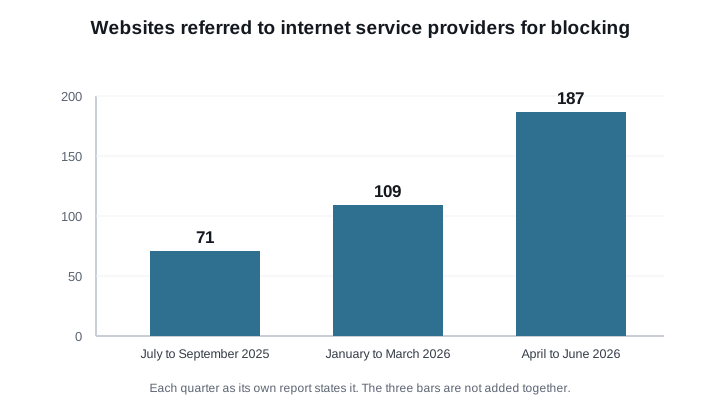
The fifth absence is about totals. No cumulative published total of blocked websites was found that could be read as a national figure, and the number in circulation on that topic is a news report rather than a regulator's own number. The figure below records the quarterly referrals as each quarter's own report states them and does not add them together. The habit of adding published figures into a total that no one published is exactly the habit this page is trying to make visible, because it is the same habit that produces national machine counts and national loss figures out of a single state's audit.
How to read the online side after the venue side
Having set out what the venue record contains, the online side can be read more sharply. The first thing to notice is what a website is not. It is not a venue, it is not licensed by an Australian state for casino play, and it is not subject to the machine standard. The second thing to notice is what follows from that: the questions that work at a venue do not work online. At a venue you can ask which regulator supervises the room, which Act applies, and what measures the venue must operate. Online, those questions have no Australian answer for casino play, and a site that offers one is either describing a different licence category or describing something that does not exist.
The practical reading method is to separate the claims an operator makes into two piles. In the first pile go claims that could in principle be checked against a public register: the corporate entity, the licence number, the jurisdiction that issued it. In the second pile go claims that could only be checked against a technical standard, such as a return to player percentage or a game's behaviour. The first pile can be worked through with the regulator's own register. The second pile cannot be worked through at all in the Australian context, because there is no Australian standard for online casino games against which to check it. That is not a reason to dismiss the second pile; it is a reason to hold it at the value the evidence supports, which is unverified.
The third thing to notice is that the online market is not lawless in every respect. As the Queensland regulator's page records, many online providers are licensed by the Northern Territory government, and providers are regulated by the state that licenses them. What that means in practice is that for the categories a state licenses, there is a regulator and there are conditions. It does not mean that a licence exists for online casino play, and it does not mean an operator's pokies are covered by the machine standard. The licensed categories and the unlicensed category sit side by side, and marketing tends to blur them. A reader who keeps them apart is already ahead of most of the material in circulation.
The comparison tool for venues on this page is the only comparator used here. It is a venue comparator, and it is presented as such. It does not compare operators, it does not rank websites, and it does not pretend to resolve the online questions the previous paragraphs raise. Where this site does analyse operators, it does so on the terms set out on the pages linked below, and the assumptions behind those analyses are stated openly rather than buried. The point of keeping the venue comparator separate is to avoid exactly the confusion this page began with: the mixing of a physical, regulated world with a digital, largely unregulated one on a single screen.
Finally, the travel cost calculator below is a small practical tool for the venue side of the question. If the search was pokies near me in the physical sense, the cost of getting there is part of the answer, and it is worth seeing before rather than after. It does not price anything else, it does not estimate losses, and it makes no claim about what a visit will cost beyond the travel.
[agbo-table]
Your own arithmetic on the cost you enter.What a trip to a venue costs
What emerges from putting the two halves together is a page that is deliberately uneven. The venue half has numbers, statutes, a standard, and an audit. The online half has an absence of rule and a set of operator claims that cannot be checked against any Australian instrument. That unevenness is the finding. Anyone searching pokies near me deserves to know which half of the results they are reading, and the answer is that the link between them is thinner than the search results suggest.
Frequently asked questions
- Does this page list venues with addresses and opening hours?
- No. This page names no casino, address, or opening hours. The venue material here is about the regulatory record, the published machine count for one state, and the harm minimisation measures that apply there, not about individual establishments.
- Is the 87,749 figure a national machine count?
- No. It is the count of gaming machines in clubs and hotels in New South Wales at June 2024, as the state's Audit Office published it. This page does not name a national machine count, because no source reached supports one.
- Does the Australian/New Zealand Gaming Machine National Standard apply to online pokies?
- No. The standard was issued by state regulators for gaming machines in venues and regulates nothing online. A parameter taken from it is a parameter about a machine in a club or hotel, not about a game on a website.
- What is the minimum return to player for an Australian pokie?
- This page does not state one. Clause 4.15 of the standard requires a return greater than or equal to [MINRTP], where the value is set in Appendix B, and Appendix B could not be read. The parameter exists; its value was not reached, so no percentage is given for Australia or for any state.
- Why is there no spin speed figure on this page?
- Because none was found in the sources reached. No minimum game cycle time, spin duration, or spin speed appears in the material, and the British figure of 2.5 seconds belongs to a different jurisdiction and is not imported here.
- If a website advertises a return to player percentage, does that mean a regulator has checked it?
- Not in the Australian context. There is no Australian licence for online casino play, so there is no licence condition and no technical standard against which an online game's published figure could be checked. The figure is unverified, which is not the same as false.
- Does a state licence for online providers mean online casino play is licensed?
- No. The Queensland regulator records that providers are regulated by the state that licenses them and that many online providers are licensed by the Northern Territory government. That is a licence for the categories a state licenses, not a licence for online casino play, and it does not bring an operator's games under the machine standard.
- Can I add the quarterly blocking figures into a total?
- No cumulative total is published anywhere that could be read, and the figure in circulation is a news report rather than a regulator's own number. The chart records each quarter's own reported figure, 71, 109, and 187, and does not add them together.
Licensing note
This page is published by an editorial site that analyses operator terms and the public regulatory record. It does not operate pokies, take bets, or hold any gambling licence. Nothing here asserts that any form of play is lawful or unlawful for any person, that any agreement is enforceable, or that any particular right exists or does not exist. The New South Wales figures and measures described above come from the Audit Office of New South Wales and apply to that state; they are not generalised to Australia. The machine standard described above applies to gaming machines in venues and regulates nothing online; its minimum and maximum return parameters sit in Appendix B, which could not be read, and no return percentage is stated here. No source reached states which state or territory licenses a land-based casino or on what conditions, and this page names no casino licensing regime. Where a figure is presented as a claim rather than as a regulator's number, it is labelled as such.
Where to go next
- Australian online pokies the online side of the same word, and why the expectations carried from venues do not transfer.
- Best Australian online casino how this site approaches operator comparisons without treating marketing as evidence.
- Live casino Australia what the record supports and what it does not about land-based establishments.
- Minimum deposit casino Australia deposit thresholds and the terms attached to them, read against the operator's own wording.
- Reading the offers a method for separating checkable claims from claims that cannot be checked.
- The margin we assume the assumptions behind any cost estimate on this site, stated openly.
- Knowing when to stop practical material on limits and on the absence of imposed limits online.
- How this site is paid the commercial arrangements behind the editorial, set out plainly.