Cashback casino Australia
Cashback is a rebate on losses, not on deposits. This page explains the three numbers that define any cashback offer (rate, base, frequency), how wagering conditions change the value of a rebate, and what Australian regulators publish and do not publish about incentives aimed at players. It sits under the crypto casino hub as a category explainer for readers comparing offers.
This page contains advertising and promotional placements. Some links on this page are paid placements and their order may have been purchased. Descriptions supplied by providers are reproduced without alteration. No figure on this page has been checked against the source it came from. Readers should treat every number below as a claim reported by the party that made it, not as a verified fact. For how commercial placements work here, see How this site is paid. Nothing in this block is a ranking, scorecard or recommendation, and no operator is named or endorsed.
Offers in this block are advertising. Placement and order are paid. The wording inside each entry is supplied by the operator and reproduced without alteration. Terms are set by the operator.
- welcome package 100% up to 4000 aud + 1200 fs + bonus game
- first deposit bonus 100% up to 1000 aud + bonus game + 300 fs
- second deposit bonus 100% up to 1000 aud + 300 fs
- first deposit bonus 120% up to 5000 aud + instant bonus round + 250 fs
- second deposit bonus 100% up to 2500 aud + 250 fs
- third deposit bonus 80% up to 2500aud + 250 fs
- welcome package 600% up to $4800 + 255 free spins
- daily cashback 10%
- weekly rakeback bonus! the genie grants your wishes!
- CRYPTO WELCOME BONUS 140% UP TO 1,600 USDT +140 FS
- CASINO WELCOME PACK 570% Up To $11,400 + 270 FS
- VIP WELCOME PACK 850% UP TO $27,000
- starting bonus package up to 5200 au$ + instant bonus round + 1500 free spins
- first deposit bonus 100% up to au$300 + instant bonus round + 100 free spins
- highroller bonus 100% up to au$3,000
What cashback means in a casino context
Cashback in a casino context is a return of part of a loss. A player loses money on play, and the operator returns a share of that loss. The mechanism is straightforward, but the wording around it is loose, and the looseness is where readers get caught. Three phrases get confused constantly: cashback, bonus credit and deposit match.
A deposit match is tied to money coming in. A player deposits, the operator adds a percentage on top, and the player now has a balance larger than the deposit. A bonus credit is usually a fixed or percentage sum added to the account with conditions attached, often triggered by a deposit or a code. Cashback is tied to money going out. It is calculated after the dust settles, from the loss, not from the deposit. That single distinction changes the arithmetic completely, and it is the first thing to check in any offer.
Consider the same player under two offers. One is a one hundred per cent deposit match on a two hundred dollar deposit. The other is ten per cent cashback on a two hundred dollar loss. The first gives three hundred dollars to play with, but the extra hundred is bonus money carrying wagering requirements and frequently a cap on what can be withdrawn from it. The second gives twenty dollars, but it is calculated after the loss has already happened, so the player knows exactly what the rebate is worth before claiming it. Neither is automatically better. They are different shapes, and they answer different questions. The deposit match answers how much can I play with. The cashback answers how much do I get back if the play goes badly.
Most retail cashback schemes in Australia outside gambling are familiar to readers: a percentage back on a purchase, paid in points or credit. Gambling cashback borrows the word but not the shape, because the base is a loss, not a purchase. A purchase secures an asset. A loss is gone. A rebate on a loss softens the fall; it does not restore what was spent. That matters for how readers should value the offer. A ten per cent rebate on a loss does not mean the player only lost ninety per cent. It means the player lost, and then got ten per cent of the loss back, provided the conditions permit the claim. If the conditions are heavy, the effective return is far lower than the headline rate suggests.
Cashback also differs from comps and loyalty schemes, which reward volume of play regardless of outcome, and from prize draws, which reward participation with a chance at a reward rather than a rebate. Cashback sits specifically on the loss side of the ledger. When a product page says cashback casino, it is describing operators that advertise a portion of losses returned on some schedule, usually daily, weekly or monthly. The schedule is one of the three numbers discussed below, and it is frequently the least prominent item on the page.
The category is also used loosely by operators who mean something else. Some use cashback to describe a week of free spins, or a small credit for a failed deposit, or a loyalty tier perk that triggers only for high volume players. Readers should not assume the word means the same thing across pages. The only reliable approach is to find the three numbers and read the terms that govern them. Sections below set out what those numbers are and what to do when one of them is missing.
One more distinction matters for Australian readers. Cashback is a form of bonus, and bonuses are governed by rules that differ by where the operator holds a licence and which government made the rule. Cashback is not a loan and is not credit in the legal sense discussed in later sections; it is a portion of the player's own lost stake returned under conditions. This page uses cashback, rebate and bonus in their ordinary commercial senses. It does not use cashback as a synonym for any regulated credit product, and readers should be sceptical of any page that does.
The three numbers behind every cashback offer
Any cashback offer, from any operator in any jurisdiction, can be broken down into three numbers: the rate, the base, and the frequency. If a page gives all three, the offer is at least legible. If it gives one or two, the offer is being sold rather than explained. The appendix on reading the offers covers this in more detail, and the notes on the margin we assume explain how an assumed house edge interacts with a rebate.
The rate is the percentage of the loss that comes back. Ten per cent, five per cent, twenty per cent. The rate on its own tells the reader almost nothing, because the value of a rebate depends far more on the base and the conditions than on the headline rate. A five per cent rebate with no wagering and no cap is often worth more in real terms than a twenty per cent rebate locked behind heavy conditions and a low withdrawal cap. The rate is the number marketing leads with because it is the biggest and simplest. Readers should treat it as the last number to trust, not the first.
The base is what the percentage is taken from. This is where most confusion lives. A cashback offer may be calculated from the deposit, from net losses over a period, from gross losses, from turnover, or from the difference between wins and losses on a defined set of activity. The base determines whether the rebate is meaningful or decorative. A rebate on deposits is really a form of deposit bonus in disguise. A rebate on net losses is closer to the ordinary commercial meaning of cashback. A rebate on gross losses ignores wins entirely, which can produce a rebate for a player who is up over the period if the gross figures happen to favour it, a scenario operators generally avoid by defining the base carefully. Readers should find the sentence that defines the base and read it twice. It is usually in the terms, not the headline.
The frequency is how often the rebate is calculated and paid. Daily, weekly, monthly, or on request after a session. Frequency interacts with the base because a shorter period means smaller samples and more volatility. A daily rebate on net losses may pay nothing on many days and a larger amount on a few, while a monthly rebate smooths the same activity into more predictable payments. Frequency also determines when the player can withdraw the rebate, since most offers attach conditions that must be satisfied within a window. If the window is shorter than the time it takes to clear the conditions, the rebate is effectively illusory.
Three numbers, then, and a fourth condition that binds them: the wagering requirement. That is treated in its own section, because it is the single condition most likely to change the real value of a rebate by an order of magnitude. An offer with a generous rate, a sensible base and a clear frequency can still be worth very little if the rebate arrives as bonus credit with a thirty times turnover requirement attached. A reader who reads the first three numbers and stops has read the advertisement. A reader who reads the fourth has read the offer.
Two more quantities deserve attention even though they are not among the core three. The first is the cap, which limits the maximum rebate payable in a period. A ten per cent rebate on net losses sounds substantial until the cap turns out to be twenty dollars a week, at which point the player must lose two hundred dollars a week to reach the ceiling and gets nothing extra beyond it. The second is the minimum loss threshold, below which no rebate is paid at all. These thresholds and caps are where the headline rate and the actual return diverge most sharply. Readers comparing offers should record all five quantities in a row: rate, base, frequency, wagering, cap and threshold. An offer that cannot supply all five is not explained; it is advertised.
Working out the real return for yourself
The real return of a cashback offer is not the headline rate. It is the rate adjusted for the conditions attached to it, and then compared against what the player would have lost anyway. A worked method is more useful than any single figure, because the reader can apply it to whatever offer they are looking at. No specific operator figures appear here, because no published figure for offshore cashback rates or caps is available in the sources this page relies on. The method below uses assumed numbers purely to show the arithmetic.
Start with an assumed loss. Suppose a player loses one hundred dollars on play over a week. An offer paying ten per cent cashback on net losses would return ten dollars. If the rebate is paid as cash with no conditions, the player's net cost for the week is ninety dollars. If the rebate is paid as bonus credit with a ten times wagering requirement, the player must turn over one hundred dollars of wagering on the credit before it can be withdrawn. At an assumed house edge of, say, four per cent, that wagering has an expected cost of four dollars. The ten dollar rebate is now worth roughly six dollars in expectation, assuming the player can clear it and withdraw. The effective rate is closer to six per cent than ten per cent.
Scale the wagering up and the arithmetic turns quickly. Thirty times wagering on a ten dollar credit means three hundred dollars of turnover. At a four per cent edge, expected cost of twelve dollars, which exceeds the value of the rebate. The offer is now worse than nothing in expectation, because the player is spending more in expected loss to unlock the rebate than the rebate is worth. This is the calculation that most readers miss, and it is the reason a comparison focused only on rates is misleading. The rate is the easy number; the wagering is the number that decides whether the offer is worth claiming at all.
Two qualifications belong here. First, the assumed house edge matters enormously. Different products carry different edges, and a rebate that is marginal at four per cent may be worthwhile at two per cent and hopeless at six per cent. Readers should apply their own view of the edge rather than relying on any default. Second, the expectation framing assumes the player would play anyway. If the cashback offer is the reason to play, the player is not comparing rebates; the player is deciding whether to gamble. That is a different question, and the page on knowing when to stop addresses it directly.
A practical worksheet for readers comparing offers:
- Write down the rate, the base and the frequency as stated, then the cap and the minimum threshold.
- Find the wagering requirement attached to the rebate and convert it to an expected cost using an assumed edge.
- Subtract the expected cost from the rebate value at a representative loss level, and note whether the result is positive.
- Check when the rebate can be withdrawn and whether the conditions can realistically be cleared inside that window.
- Check whether the rebate is cash or bonus credit, and whether the cap makes the headline rate unreachable at realistic loss levels.
- Compare the adjusted figure across offers, not the headline rate.
Readers should also note the difference between cashback on net losses and cashback on turnover. A turnover rebate is paid on how much is wagered, not on how much is lost, so it behaves more like a loyalty payment than a loss rebate. The two are frequently marketed with the same word. The base tells the reader which one is on offer, and a reader who cannot find the base should assume the least favourable interpretation until the operator states otherwise. Caution here costs nothing and saves a great deal.
Finally, the rebate should be compared with the alternative of not playing. A rebate of any size does not convert a losing session into a winning one. It reduces the loss, at the cost of conditions that often require further play. A player who would not play without the cashback offer is not being rewarded for loyalty; they are being given a reason to add turnover. The arithmetic above is an aid to seeing the offer clearly, not a justification for claiming it.
Cashback and wagering conditions
Wagering conditions are the terms that determine what a rebate is actually worth. A wagering requirement is a multiple of the rebate that must be turned over before the rebate can be withdrawn. A ten dollar rebate with a ten times requirement means one hundred dollars of turnover. Players who have compared casino bonuses will recognise the mechanism, but there is an important difference in how cashback requirements are usually structured, and readers should check which structure applies rather than assume.
Bonus offers commonly attach wagering to the bonus amount. Cashback offers sometimes attach wagering to the rebate, sometimes to the loss that generated it, and sometimes to the deposit that funded the play. A requirement calculated on the underlying loss is far heavier than one calculated on the rebate. If a player loses one hundred dollars, gets a ten dollar rebate, and faces a ten times requirement on the rebate, that is one hundred dollars of turnover. If the same offer faces a ten times requirement on the loss, that is one thousand dollars of turnover, ten times heavier for the same rebate. The difference is a sentence in the terms, and it is the single most consequential sentence in the offer.
Some cashback arrangements pay as withdrawable cash with no wagering at all, particularly small weekly rebates. Others pay as bonus credit subject to the standard bonus terms. Readers should not assume either. The absence of a wagering requirement on the headline is not the same as the absence of a requirement in the terms. Where the terms are silent, the safe assumption is that the rebate arrives as bonus credit under the operator's general bonus conditions, which typically include a wagering multiple and a time limit.
Time limits deserve separate attention. A wagering requirement attached to a window of seven days requires the player to complete the turnover within that week. If the requirement is heavy relative to the rebate, the window makes it practically impossible without further deposits and further play. A rebate that cannot be cleared is not really a rebate; it is a prompt to keep playing. Readers should check the window before the multiple, because a short window can make a modest multiple unworkable while a long window can make a larger multiple feasible.
The relationship between cashback wagering and ordinary bonus wagering is worth stating plainly. They are usually the same conditions applied to a different amount. Operators rarely publish a separate wagering regime for cashback; the rebate is treated as a bonus and inherits the bonus terms. That means readers comparing a cashback offer should read the operator's bonus terms as the controlling document, even if the cashback page is separate. Where the cashback page and the bonus terms conflict, the bonus terms generally govern, and readers should assume the less favourable reading until the operator clarifies.
One structural caution. Because cashback is calculated on losses, heavier wagering on the rebate pushes the player toward more play, which tends to produce more losses, which tends to produce more rebate, which comes with more wagering. The arrangement is not malevolent in itself, but it is directionally persistent. A player who is clearing cashback wagering is, in expectation, losing more while doing so. That does not make cashback wrong to claim; it does mean the terms should be read with the arithmetic from the previous section in hand. An offer with no wagering on the rebate is straightforward. An offer with heavy wagering on the loss is not an offer at all in any meaningful sense, and readers should say so and move on.
Readers who want a structured way to read wagering terms across operators can use the method in reading the offers. The key point for this page is that cashback is a bonus category, that bonus conditions apply to it, and that the conditions, not the rate, decide the value.
Why incentive rules do not reach offshore cashback
The rules most relevant to cashback and similar offers in Australia are state and territory rules aimed at licensed operators, plus a federal framework aimed at licensed wagering providers. None of them is a rule about offshore casinos, and readers should not be told otherwise. The notes below set out what the rules cover and where their reach ends, with sources identified where the claim comes from a published instrument.
Start with the federal framework. Part 2B of the relevant Commonwealth Act, sections 15B to 15F, was inserted by Act No. 114 of 2023, and items 1 to 29 of that amending Act commenced on 11 June 2024. Section 15B prohibits a licensed provider from providing credit, and prohibits specified payment methods from being accepted, in connection with wagering. Section 15C sets prohibited inducements and carries a civil penalty of 500 penalty units under s 15C(1A). Section 15C(1) contains a separate prohibition on the provision of credit. Section 15C operates through a closed list of inducements, and paragraph (b) is one of the items in that list. Sections 15D and 15E contain further related prohibitions and requirements.
The critical point about s 15C is who it binds. Each limb of s 15C is addressed to a licensed Australian wagering operator. Section 15C does not bind an offshore casino. A rebate on losses offered by an offshore operator is not conduct to which s 15C is directed, and readers should not read this page as saying that an offshore cashback offer breaches s 15C. It does not, because the provision is not addressed to that operator. Readers will see pages that elide this distinction, and the elision usually serves an argument rather than a reader. The correct statement is narrow: the Commonwealth inducement provisions bind licensed Australian wagering operators, and an offshore casino sits outside that particular framework.
Cashback should not be confused with credit in the sense used in these provisions either. Credit in s 15B and s 15C is a regulated concept concerning money provided on terms requiring repayment, and it is not the same as a rebate on losses. A cashback offer is a form of bonus. Readers should be cautious of any page that calls a cashback offer credit in the legal sense, because the two are different concepts and the conflation makes both harder to understand. This page uses credit only where the provisions use it, and uses cashback for rebates throughout.
On inducements more broadly, the National Consumer Protection Framework measures are the clearest published statement of what licensed operators may and may not offer. Measures four and three are especially relevant. Under Measure 4, from 26 May 2019 in all jurisdictions except New South Wales, and from 26 November 2019 in New South Wales, online providers cannot offer incentives to open an account. The Queensland regulator's page on the framework states that online providers and on-course bookmakers cannot offer credit, a voucher, a reward or a benefit to encourage a person to open an account, and cannot offer an incentive for referring another person. The other framework measures apply to all licensed online wagering providers, and Measure 3 is part of that set. Readers should understand that these are conditions on licensed providers, published by the authorities that supervise them.
None of this reaches an offshore casino's cashback offer, because the rules bind licensed providers and the offshore operator is not one. That is a statement about scope, not a statement that offshore offers are good, safe or fair. It means the protections built into the Australian framework, including the incentive restrictions and the complaint routes, apply to the licensed side of the market and not to operators outside it. Readers comparing offshore offers should understand that the consumer protections they may have relied on with a licensed provider are not part of the offshore arrangement. That is the practical consequence, and it is more useful than any claim about legality, which this page does not make.
BetStop, ACIP and complaint routes
BetStop is the National Self-Exclusion Register, established under Part 2B and described in the register's own materials. Section 61KA(1) of the relevant Act provides for a civil penalty of 500 penalty units in connection with the register, and s 61GB contains related requirements. The register began operating on 21 August 2023. Its start date and its statutory basis are published facts, and readers relying on BetStop should know both.
BetStop is aimed at licensed providers. Section 61GB obliges licensed providers to give effect to a self-exclusion, and the register's design assumes an operator that is subject to the framework. An offshore casino is not within that framework, which is why the register is described here as not reaching offshore casinos. The register's own materials, including its published guidance, describe the scope. Readers can read the register's own statement on its site, and a quote from its materials reads: BetStop is the National Self-Exclusion Register for all online and telephone wagering providers. The quote is reproduced as the register publishes it. Readers should note the word wagering in that sentence; the register's design and its statutory backing are directed at the licensed wagering sector, and an offshore casino is outside it.
Readers who want to exclude themselves from licensed Australian wagering should use BetStop, because that is what it is built for. Readers who are considering an offshore casino should understand that registration on BetStop does not, by itself, bar access to or activity with an operator that is outside the licensed framework. This page does not describe any method of bypassing blocks or checks, and readers should not seek such methods here. The point is informational: the register's reach is defined by the framework it sits in. The page on casinos not on BetStop discusses the boundary in more detail.
On payments, AUSTRAC administers the Australian Customer Identification Procedure, known as ACIP, which is the customer identification framework for the financial sector. ACIP is a framework about customer identification and anti money laundering obligations, and it is not a scheme that verifies casino offers or their fairness. Readers should not read ACIP as a stamp of approval on any casino product, offshore or otherwise. Its purpose is identification and reporting, and it applies to reporting entities such as financial institutions, not to the commercial terms of a casino's rebate.
On complaints, the Australian Consumer Law provides a general framework for misleading conduct and consumer guarantees. Readers who believe they have been misled by a commercial representation may have avenues under that framework, but this page does not assert that any particular conduct breaches the law, does not assert that any remedy is available, and does not assert rights under the ACL on any reader's behalf. Legal questions of that kind depend on facts and are for a qualified adviser. What this page can say is that the ACL exists, that it is administered by the consumer regulator, and that readers with a specific concern should take advice rather than rely on a general statement from a page like this one.
A practical note on the order of checks. A reader considering an offer can check the register's scope, check whether the operator is within the licensed framework, and check the payment framework's purpose, all before evaluating the offer itself. None of these checks evaluates the cashback rate. They establish the perimeter, not the value. The value comes from the three numbers and the wagering terms. Keeping the perimeter and the value separate makes both easier to assess.
What is published and what is not
This page is deliberately specific about what is published and what is not, because the gap between the two is where most cashback marketing lives. The regulator's own figures on blocking referrals are an example of published data being misread as a cumulative total. That particular confusion is treated in the figure below and is not repeated here.
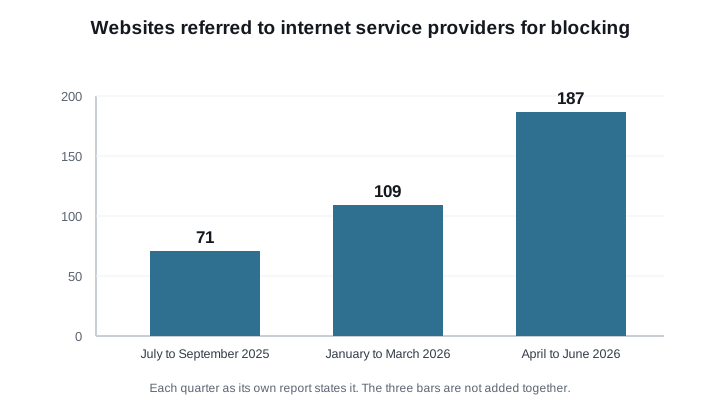
On cashback specifically, the position is stark. There is no published figure in the sources this page relies on for the size, rate, cap or terms of cashback offers at offshore operators. Nothing in the material consulted for this page states what an offshore cashback rate is, what base it is calculated on, or what wagering attaches to it. The comparators on this page therefore contain no cashback rates. That is not an omission. It is the accurate position, and readers should treat any page that presents a confident table of offshore cashback rates with caution, because the published basis for such a table does not exist in the material consulted.
The same is true of several other quantities. The framework's measurement material does not publish a single figure for the value of inducements across the licensed market, and this page does not supply one. Where an operator publishes terms, those terms are the operator's claims, not audited facts, and this page treats them as such. The distinction between an operator's own terms and an independent measurement is important for readers, because the two carry different weight. An operator's terms tell the reader what the operator says it will do. An independent measurement tells the reader what was observed. This page has access only to the first kind for cashback terms, and it says so rather than filling the gap.
Readers who want to compare concrete payment and withdrawal characteristics can use the pages on instant withdrawal casino Australia, PayID casino, E wallet pokies and minimum deposit casino Australia. Those pages deal with the plumbing rather than the rebate, and readers building a full picture should keep the two threads separate. A fast withdrawal does not make a rebate generous, and a generous rebate does not make a withdrawal fast.
Cashback questions
Licensing note
Licensing arrangements differ between the licensed Australian market and offshore operators, and readers should not assume that a licence held anywhere confers the protections of the Australian framework. The incentive rules discussed on this page, including the state and territory measures and the Commonwealth provisions in Part 2B, sections 15B to 15F, apply to licensed Australian wagering operators. The National Consumer Protection Framework measures, including Measures 3 and 4, apply to licensed online wagering providers. BetStop's obligations fall on providers within the licensed framework. None of these instruments is addressed to an offshore casino, and this page makes no claim about the licensing position of any operator. Readers evaluating an offer should establish which framework applies before relying on any protection that framework provides. This page does not assert that any operator is licensed, lawfully accessible, enforceable against, or in breach of any rule, and no statement here should be read as a legal conclusion about a specific operator. For questions about licensing in a particular case, take qualified advice.
Where to go next
- Crypto casinos the parent hub explaining the category and how crypto deposits fit alongside rebate offers.
- Bitcoin casino Australia the Bitcoin angle, including how deposits are made and what to check first.
- Instant withdrawal casino Australia withdrawal speed as a separate question from rebate value.
- E wallet pokies wallet-based play and the practical differences readers should know about.
- PayID casino payment rails and what they mean for deposits and withdrawals.
- Casinos not on BetStop the boundary of the self-exclusion register explained without any bypass instructions.
- Reading the offers a structured method for reading terms, wagering and caps across operators.
- Knowing when to stop the question that matters more than any rebate, and where to find support.
- Minimum deposit casino Australia small-deposit play and how it interacts with rebate thresholds and caps.